Matsumoto Night Cassette — Four Late Hours Around the Station
MatsumoTone
MatsumoTone

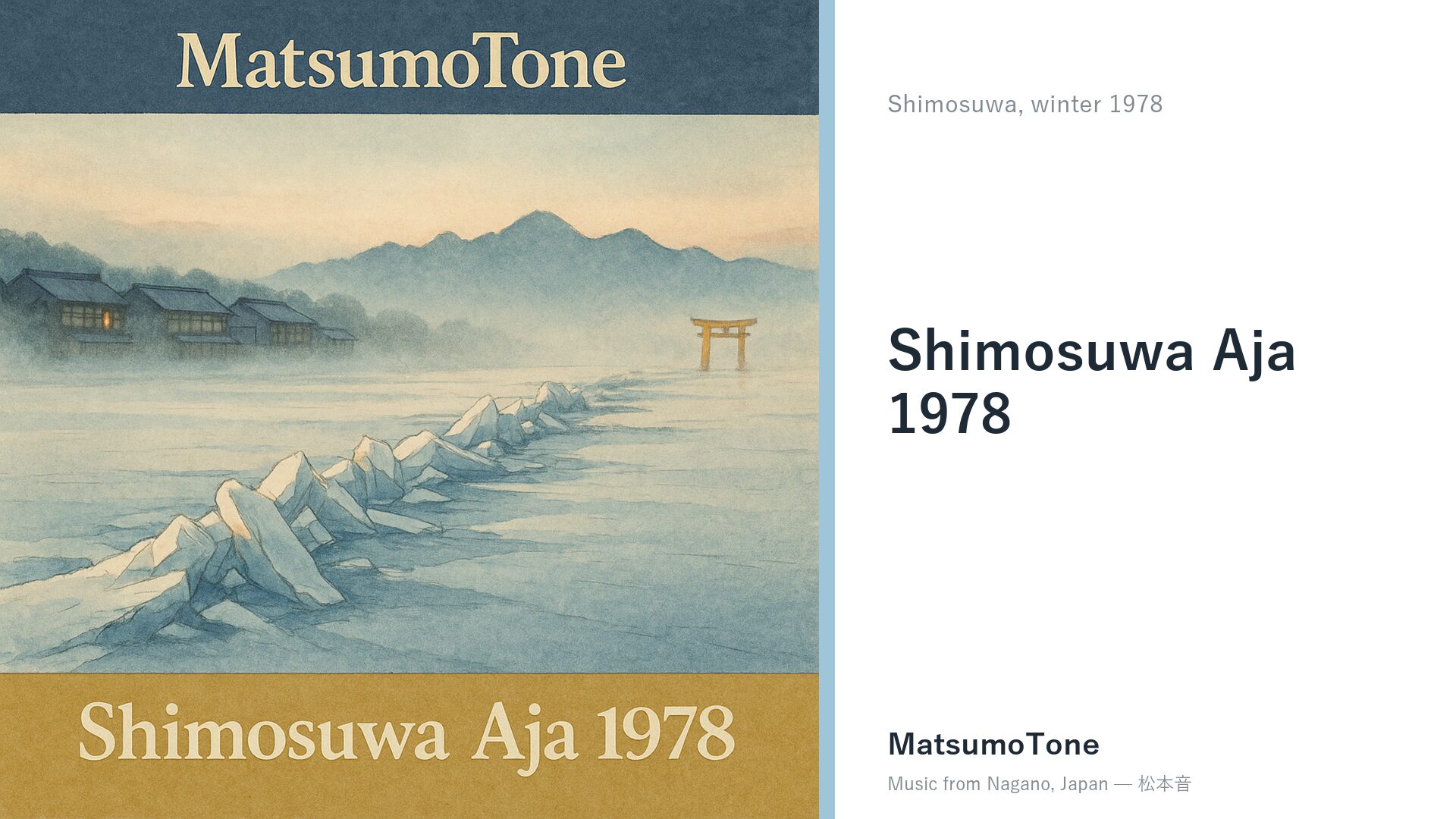
There is a morning, in the deep cold of February, when Lake Suwa cracks itself open. The ice does not simply split. Pushed from both shores, it buckles and heaves upward along a single diagonal seam, a low ridge of broken pale plates standing thirty to eighty centimetres above the flat of the frozen lake. The people of Suwa have a name for it that is older than any record label, older than any genre: omiwatari, the crossing of the gods. Shimosuwa Aja 1978 is a record that begins at six in the morning on that ice, and never really leaves it.
Shimosuwa is a small place with three lives stacked on top of each other. It was the only hot-spring post-town on the old Nakasendo, the inland highway between Edo and Kyoto, so it has the formality of an inn town that once received daimyo and pilgrims. It is the seat of the lower Suwa Taisha shrines, Harumiya and Akimiya, where the Onbashira festival drags great cedar pillars down the mountain once every six years. And by the late twentieth century it had become a town of precision — the wider Suwa basin grew into one of Japan’s watch-making and fine-mechanism centres, close enough that people half-jokingly called it the Switzerland of the East.
This album imagines that town in a single year, 1978, and listens to all three lives at once: the pilgrimage out front, the hot-spring alleys round the back, the formality of the post road, and the fluorescent hum of the night shift.
To hold those things together I borrowed a very specific sound — the late-1970s West Coast studio jazz-rock that a certain kind of listener will recognise within a few bars: warm electric piano, precise horn charts, a dry mid-range male voice, and a narrator who never raises it. I will not name the records; the song titles and the voice will give the game away to anyone who already knows. It is an unlikely lens for a Shinshu shrine town, and that is exactly why it works. That music was built on two things that suit Shimosuwa perfectly: a cool, observational narrator who watches more than he confesses, and a session-musician perfectionism where every Fender Rhodes chord and every tenor-sax line is placed with almost cruel precision.
So the harmony here is deliberately sophisticated — extended chords, chromatic glides, a long saxophone solo allowed to take its time — and the voice on top of it is never quite warm. It keeps count. It notices the guest who left without paying, the priest who has not spoken since November, the factory that may already have been sold. The morally ambiguous narrator of West Coast studio pop turns out to be the right witness for a town balanced between the sacred and the everyday.
The record is a song-cycle, and it moves the way a single long winter day might.
It opens on the lake at dawn, the owner’s wife already shouting in the inn kitchen, the shift workers from the precision factory drifting home with wax-paper bags from the bakery. It moves to the shrine for the first ritual of the year, where the kami have stayed another year in the cedar and the man who sweeps the gravel path is older than the trees. At its slow centre sits the keeper of an old honjin, born in the capital, who has decided he will die in a building from 1660 and let his daughter sell it afterward — a failure’s hymn, sung without bitterness.
Then it turns, and lets in the living town. A young woman comes up from Tokyo to learn the watch trade on the night shift, and within six months is faster than the men beside her. Rumours move through the hot-spring back streets the week before the festival — a priest’s son gone to Osaka, the factory quietly signed over to Tokyo lawyers, and a stranger who comes every winter who is, it is whispered, a writer collecting tales of failing towns. The record closes back on the ice under a February moon, the same Rhodes and the same saxophone as the opening, the narrator finally speaking in his own voice as the omiwatari holds the lake together for one more year.
I am not a trained composer, and I am still working out how to do this honestly. But the idea behind the whole project is simple: a region is worth the same care a great record gives a city. The studio-pop tradition lavished its precision on Los Angeles and New York. There is no reason a frozen lake, a watch factory’s night shift, and a 1660 inn cannot carry the same weight — they only lack someone to keep count.
Shimosuwa already has its crossings of gods and its cedar pillars. This is just one more small record laid beside them, an attempt to hear how Shinshu might have sounded in the winter of 1978.
This is part of the point of the project, so I will show the work. Every MatsumoTone record begins as a written recipe and is then realised with an AI music generator; the craft is in writing the recipe well, not in hiding it.
The method was simple to state and hard to get right: take the cool, perfectionist template of late-1970s West Coast studio jazz-rock — a dry observational narrator, extended jazz harmony, a horn section placed with almost surgical precision — and re-point every one of its coordinates at Shimosuwa in 1978. The harbour becomes a frozen lake; the Los Angeles session players become one touring musician recording in the mountains; the cynical city narrator becomes a winter visitor watching a post-town.
The palette stays fixed across all six songs, the way a real album band would: Fender Rhodes and a Steinway grand, a fretless electric bass, a tight studio kit led by the ride cymbal, a five-piece horn section, a tenor saxophone for the long solos, a dry mid-range male voice, and a small soul chorus on the hooks. The grooves lean soul and R&B; the harmony leans jazz. Each song then gets its own coordinates:
The written instruction for the opening track reads, in part:
late-70s West Coast jazz-rock, mid-tempo cool urban groove,
98 BPM, G minor to B-flat major, Fender Rhodes lead,
five-piece horn section entering the chorus,
dry mid-range male narrator, clean cadence with no fade-out
The rest of the recipe is just that, six times over, pointed at a cold lake.
One honest caveat about all of this. A key, a tempo, a chord move — these are intentions, not guarantees. The music is generated, and a generator never follows the recipe to the letter, so what you actually hear will drift from what is written here. Read the keys and tempos as the concept of each piece, not as a spec sheet. Half the pleasure is hearing which chord it refused to resolve.
One honest aside on the craft. I recently started mastering these records with Ozone 12, from iZotope — now part of Native Instruments, and lately under inMusic — and the difference is not subtle. The low end finally sits, the highs stop biting, and the whole album simply holds together as one loudness. I am an amateur and I will happily admit it: hearing a mix tighten up like that has been pure pleasure, and it is a large part of why this record sounds the way it does.
Shimosuwa Aja 1978 is best heard in order, from the first fog on the lake to the last note over the ice.
▶ Listen on Spotify, Apple Music, Amazon Music and everywhere else: open the album
This page contains affiliate links. As an affiliate I may earn from qualifying purchases.
All six songs, in order. They are written as a single winter cycle: the same narrator, the same lake, one year.
The fog is on the lake at six in the morning
The Nakasendo runs past the inn at the corner
The owner's wife is shouting at a kid in the kitchen
Something about a guest that left without paying again

The kid does not answer, he just folds the linens
The wife keeps talking until the temple bell sounds
I am sitting at the window looking at the omiwatari
Where the ice runs diagonal across the sleeping water

CHORUS
Lake Suwa dawn — the year is 1978
A train goes by, the ice keeps cracking
Lake Suwa dawn — the prefecture is asleep
And I am the only one who is keeping count

The shift workers from the precision factory pass through
Carrying small wax-paper bags from the bakery
Their voices are low, their faces are tired
They have made another night of springs and small wheels

(CHORUS)The first priest comes through the gate at four
The morning is colder than December usually allows
The shrine grounds are silent except for the gravel
And one crow that does not know any better than to call
CHORUS
Shimosuwa Aja — the bells are answering
The kami have stayed another year in the cedar
Shimosuwa Aja — the tourists are sleeping
And the man who sweeps the path is older than the trees
The chief priest enters with his crested robes folded
Behind him follow two younger men in white
They do not speak — they have not spoken since November
And they will not speak until the ice returns to ridges in May
(CHORUS)
By dawn the offerings are arranged on the stone platform
A small bowl of sake, three grains of rice, salt in a paper
The chief priest reads from a scroll that no one is hearing
The kami listen — or they do not — and the year begins
(CHORUS)I was born in the capital but my name does not survive there
I bought this old honjin from the family that could not keep it
The roof is original, the floorboards have been replaced twice
And the room at the back is the one where the daimyo used to wait
The traveler stops here when his car will not run further
Tomorrow he will be in the next prefecture by lunchtime
He does not know the building has been here since 1660
And it does not matter to him, and that is exactly as it should be
CHORUS
Nakasendo blues — the post-road is closed
The trucks take a different highway round the lake
Nakasendo blues — the building is closed too
But the man who runs it is the man who is still inside
My daughter says I should sell and move down to Tokyo
She has a couch and a small room I could have
I have told her three times: I will die in this building
And she will then sell it, and that is exactly as it should be
(CHORUS)She came up on the limited from Tokyo in October
Said she wanted to learn the trade and save a little money
The line manager smiled and said this is not Tokyo Lily
Where the hours are short and the pay is more than a man's
Six months later she is faster than the men beside her
She can do the spring barrel and the third wheel in a minute
The manager calls her by her name and she does not flinch
Tomorrow she will earn what he earned in his second year
CHORUS
Precision factory Peg — the night shift hum
The fluorescent and the hum, the small wheel turning
Precision factory Peg — the line is silent
Until somebody drops a part and three voices turn
At dawn she walks to the bus that takes her back to her room
A small place on the second floor of a house near the lake
She will sleep until two, then come back and do it again
And in five years she will be the supervisor of the line
(CHORUS)There was a rumor going round the shrine this afternoon
That the priest's elder son had quietly left town for Osaka
Taking with him the wife of the man who runs the noodle shop
And a sum of money that was not entirely his to take
There was another rumor going round the precision factory
That the foreign visitors who came last month were Tokyo lawyers
And that the owner's wife had quietly already signed the papers
And that come April the line would be running half its current shifts
CHORUS
Onbashira rumor — the festival is coming
The carpenters are shaping the cedar by the lake
Onbashira rumor — the season is starting
And the news is older than the kami in the trees
There was one more rumor going round the inn at the corner
That the man who comes through every winter from somewhere up north
Was not in fact a businessman, was not in fact a salesman
Was a writer for some magazine collecting tales of failing towns
(CHORUS)The omiwatari ridge runs from the southern shore to the north
Diagonal across the lake under a winter full moon
I am standing on the small wooden pier by the inn at the corner
The same one where I stood at dawn six months ago in July
I came here to write something — I do not remember what
The magazine that sent me has folded sometime in November
The check that they sent in October was the last that they will send
And the woman I came up with has been gone since early December
CHORUS
Omiwatari closer — the kami have crossed
The ice ridge will stand until April or May
Omiwatari closer — the year is ending
And I am home at last where I never thought I would stay
I will stay another year, or I will stay until I die
I have rented the small upstairs from the woman who runs the inn
She will cook for me when she has time, and I will sweep her shrine path
And neither of us will say that this is what marriage looks like
(CHORUS)This is a recipe site, so here is the actual recipe. Below is the written style prompt for each of the six songs, more or less as used. Real artist and album names are kept out on purpose — the sound is described, not borrowed by name — and a key or a tempo is, again, an intention rather than a guarantee.
late-70s jazz-rock fusion vocal, mid-tempo cool urban groove, 98 BPM, G minor to B-flat major modulation, Fender Rhodes Mark II suitcase lead (LA studio warmth, tremolo medium, jazz extension comping), Steinway D grand piano selective (drop-2 voicings on chorus), Strat-style clean guitar with chorus pedal (jazz chord drop-2 voicings), fretless electric bass fingered (precision walking line, slight pick attack), drum kit tight studio (snappy snare 2 and 4, ride cymbal led with bell accents, ghost notes on hi-hat), horn section 5-piece (2 trumpets + tenor sax + alto sax + trombone) entering chorus with harmonized stabs, tenor sax obbligato through verses (mid-range warm tone), male lead vocal mid-range cynical observer narrator, backing chorus 2-3 LA session female voices smooth blend on hooks, vibraphone color tones on chorus only, late-70s West Coast studio perfectionism aesthetic, secondary dominant chain (V7/iv V7/iii V7/ii V7/V), no fade-out clean cadence on Bbmaj7late-70s jazz-rock fusion vocal extended centerpiece, 87 BPM, F-sharp major modulating to D-sharp minor (complex jazz-rock chord glide), sophisticated harmony with extended chords (major7 dom9 m7b5 altered dominants), Fender Rhodes Mark II suitcase as primary keys (jazz comping rootless voicings), Steinway D grand piano selective stabs, Strat-style clean guitar with jazz chord melody, fretless bass fingered precision (walking eighth-note feel), drum kit tight studio (ride cymbal forward, brushed snare on verses sticks on solos, complex tom fills), tenor saxophone primary solo voice (extended 64-bar solo through bridge, breathy mid-range, lyrical), horn section 5-piece harmonized stabs on chorus turnaround, male lead vocal smooth mid-range observational, backing chorus 3 LA session voices on chorus hooks, vibraphone color tones, late-70s West Coast studio perfectionism, modal interchange between F# major and D# minor, no fade slow ritardando ending with held sax note over Rhodeslate-70s jazz-rock fusion vocal ballad, slow life-philosophy meditation, 75 BPM, A-flat major, Steinway D grand piano primary lead (rolled chords verses, arpeggiated choruses, major7 add9 voicings), Fender Rhodes Mark II suitcase secondary coloring (Rhodes warmth chorus, slow tremolo), chamber strings six-piece entering verse 2 (soft swell chorus, breath between phrases), male lead vocal warm tenor (intimate close-mic, slight breath, world-weary, resigned not bitter), backing chorus 3 LA voices final chorus only (round soulful), fretless bass moving root-fifth quietly with slow walks, brushed drum kit side-stick (no fill until final chorus), tenor sax obbligato verses 2 and 3 (sub-tone breathy mid-range, slow phrasing), trombone entering bridge (low warm pad), late-70s West Coast ballad aesthetic Japan-adapted, dominant9 to major7 turnaround chorus, slash chord descending bass verse end, fade out on held piano major7late-70s jazz-rock fusion vocal uptempo hook, 111 BPM, B-flat major verse to D minor chorus chromatic modulation, tight studio perfectionism, Fender Rhodes Mark II suitcase comping (rootless voicings verses, jazz extensions chorus), Strat-style clean guitar with chorus pedal (16th clean comping, hybrid picking dyads chorus), Steinway D piano stabs chorus turnarounds, Mini-Moog Model D mono synth lead playing hook line (8-bar unison with vocal melody chorus), fretless bass fingered fast walking line (anticipates the one, syncopated 16th), drum kit tight studio (snappy snare 2 and 4, ghost notes 16th hi-hat, ride bell accents), horn section 5-piece harmonized stabs chorus turnaround (sharp three-note ascending figure), male lead vocal smooth mid-baritone (tight pitch, cool observer), backing chorus 3 LA voices on hook smooth blend, vibraphone color tones, late-70s West Coast tight uptempo, chromatic chorus modulationlate-70s jazz-rock fusion vocal rumor groove, 105 BPM, C minor with mediant modulations (Eb major and Ab major borrowed territory), late-70s West Coast studio perfectionism, Fender Rhodes Mark II suitcase comping (rootless voicings verses, m7b5 chorus), Strat-style clean guitar with chorus pedal (drop-2 voicings, chord melody fills), Hammond B3 organ swells bridge (slow rotary), Steinway D piano stabs chorus turnarounds, fretless bass fingered (fast walking eighth with chromatic passing tones), drum kit tight studio (snappy snare 2 and 4, ghost notes 16th hi-hat, ride bell accents), horn section 5-piece harmonized stabs (sharp four-note descending figure chorus), male lead vocal mid-baritone narrator (amused observational, slightly mocking key lines), backing chorus 3 LA voices choruses (smooth blend, raised-eyebrow tone), tenor sax obbligato verses (cynical mid-range), mediant modulations chorus turnarounds, fade on Cm9 vamplate-70s jazz-rock fusion vocal closer ballad, slow reflective home-at-last, 69 BPM, G major to E minor returning warmth, bookend to Track 1 in G minor, Fender Rhodes Mark II suitcase primary lead (warm tremolo medium, jazz extensions), Steinway D piano stabs (drop-2 voicings chorus), chamber strings six-piece sustained (long-tail swell), male lead vocal warm tenor (intimate, first-person reflective, gentle), backing chorus 3 LA voices choruses (round soulful, wider final), fretless bass root-fifth quiet (sustained warm), brushed drum kit side-stick (soft ride no fill), tenor sax obbligato verses 2 and 3 (sub-tone breathy), extended tenor sax outro from final chorus to fade (lyrical over strings, recalls the Track 1 motif), lake-wind ambience intro and outro (subtle high-end, panned wide, long decay), late-70s West Coast closer aesthetic, slash chord descending bass verse ends, end on held Gmaj9 with sax outro fadeRead the keys and the tempos as intent, not as measurement. The omiwatari picks its own line across the lake every February, and nobody standing on the shore has ever been able to say in advance where the seam will run. These six came back the same way.
Some streaming links on this site are affiliate links. See our Affiliate Disclosure for details.