Shimosuwa Aja 1978
MatsumoTone
MatsumoTone

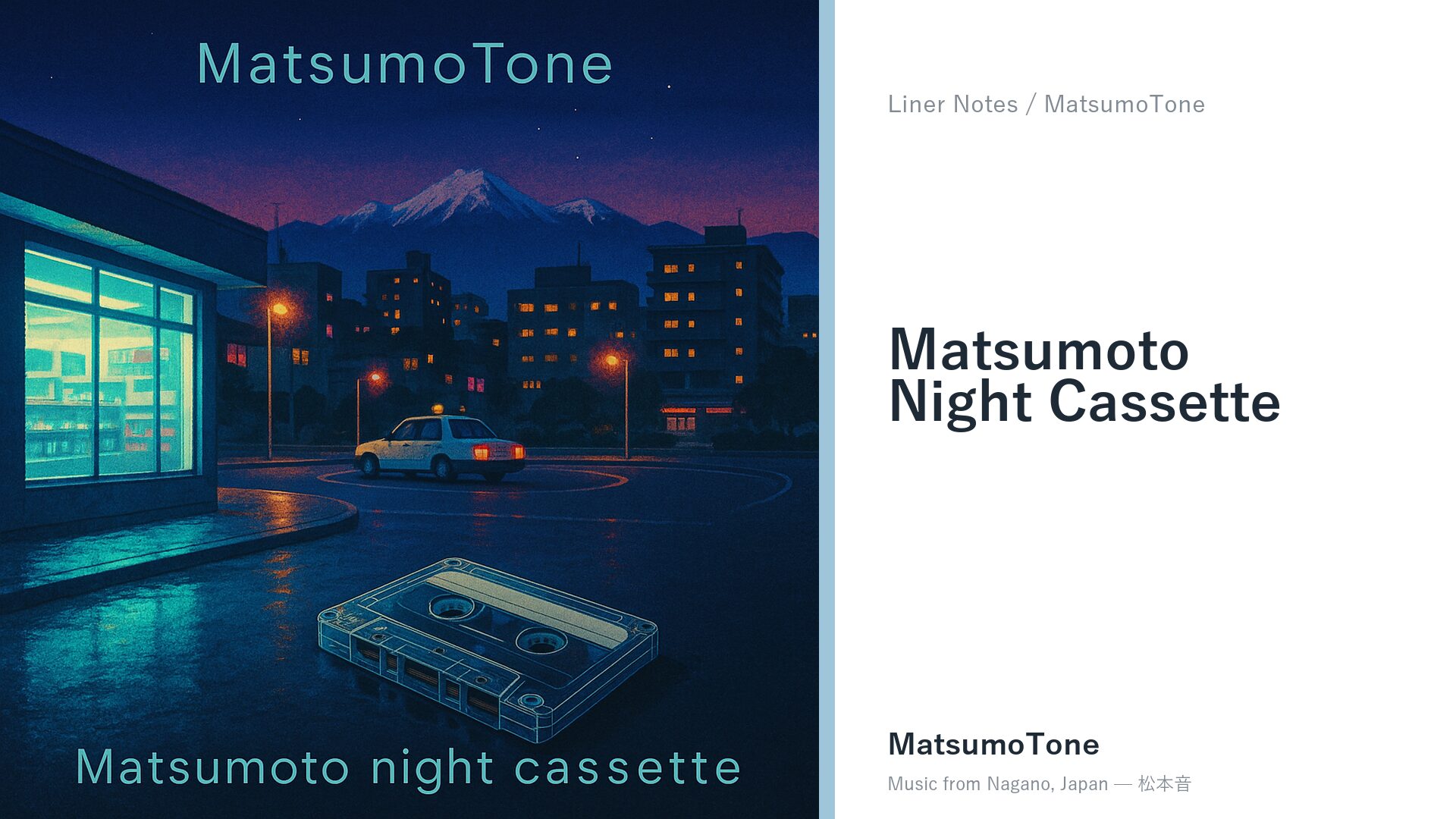
The 80s called city pop a Tokyo thing. It was not, quite. Every Japanese city had its version. In Matsumoto in 1985 it was the karaoke lounge on the top floor of the hotel by the station, the convenience store at 11:30 p.m. with the magazine rack still full, the last the Kamikochi Line train rolling out to Shimajima.
Matsumoto Night Cassette is the third MatsumoTone mini-album. Four female-vocal pop pieces, about sixteen minutes, set in the small night radius around Matsumoto Station.
The international revival of Japanese city pop — Mariya Takeuchi, Taeko Onuki, Tatsuro Yamashita streamed millions of times by listeners in Berlin and São Paulo and Brooklyn — usually centres on Tokyo. That is fair to the original recordings. But the genre’s emotional vocabulary — the late-night drive, the convenience-store fluorescence, the slow saxophone interlude in a hotel lounge — was available in every regional Japanese city. This album takes that vocabulary back into a smaller place.
Where Yorimichi drew the daylight version of Matsumoto, this album draws the night version. Same city, different temperature, different palette: Rhodes electric piano, DX7 pads, slap bass, gated reverb snare. The structural intent: the same person, a different self after dark.
1. Convenience Store Window — 9:30 p.m. The narrator is outside the 7-Eleven on the Castle Exit side of the station, watching strangers through fluorescent glass. The piece is in A major, the brightest place in the album. A short DX7 marimba phrase opens the song like an automatic door.
2. Park Hotel Karaoke — 11:00 p.m. Up on the top floor of the hotel by the station. Smoked glass, low leather booths, the alps black against the windows. F-sharp minor — the relative shadow of A major — and a tenor saxophone solo in the second chorus that does not quite resolve. Karaoke has always been a place to half-finish a feeling.
3. Last Train to Shimajima — 11:35 p.m. The Kamikochi Line, the small private line that runs west from Matsumoto toward the mountains, ends its run at Shin-Shimajima. The vocoder harmony in the second verse imitates the platform announcement. Key of D major: a IV-of-A widening, the train pulling away from the centre of town.
4. Taxi Home — 12:30 a.m. A field recording of light rain underneath an ambient synth pad. The taxi is taking you back through Fukashi and Daimyocho toward home. A major returns, but warmer now, slowed down. The album closes the loop without resolving the loneliness.
Each MatsumoTone release frames a particular Matsumoto location as listening material — the concept post explains the approach.

Cassettes were the dominant private listening format in Japan from roughly the late 1970s through the mid-1990s. They were what city pop was first heard on. Their compression curve — the slight high-frequency roll-off, the warm low end, the audible tape hiss between tracks — became inseparable from the genre’s identity. Matsumoto Night Cassette wears that mastering bias deliberately: the highs are softened, the snare is dry, the sub-bass is gently rounded off rather than punched. It is not a tribute to the format so much as an admission that this music exists inside that format’s logic. Listening to it on perfect digital playback misses the point by half.
Night, in this album, is treated as a duration rather than a setting. The four pieces do not narrate a single linear evening — they sample four different hours from four different nights, and each one has its own atmospheric density. A late commute home. The last train. A walk back from a bar that closed too early. The forty minutes after midnight when the city’s mechanical systems quiet down and the air audibly cools.
The gated reverb on the snare across the album is slightly too aggressive for my taste in hindsight — a touch too 1984 SSL, not quite 1986 enough. I have left it. The whole album is supposed to be a cassette, after all. Cassettes preserved that snare sound as a fingerprint of their decade.
For the daytime counterpart to these late hours, see Yorimichi.
Most Matsumoto music — including most of this label’s other releases — points west, toward the castle and the alpine wall behind it. This album does the opposite. It stays on the east side of the Metoba River, near the station, in the part of the city that is functional rather than picturesque. Office buildings, parking structures, business hotels with their fluorescent foyers, the convenience stores that stay open all night. This is the city most residents actually live in, and it is the city that city pop was always really about — not the postcard, but the strip of asphalt under the office worker’s feet on the way home.
Treating that ordinary geography as music-worthy is part of the genre’s quiet political move. City pop did not romanticise the countryside, did not yearn for a lost rural Japan, did not orient itself around festivals or seasons. It pointed at the office tower and the parking ramp and said: this is also a place that can hold a song. Matsumoto Night Cassette takes that orientation seriously and applies it to a smaller city than the genre is usually allowed to touch.
The album was sequenced for a specific listening posture: seated, lights low, slightly tired, half-listening, allowed to drift. The snare is dry rather than crisp because a tired body does not want to be hit hard by a snare at this hour. The bass sits in the range of speech rather than the range of a club, so it does not interfere with the small inner narrations a tired person carries home. The chords are extended and the resolutions are deferred because end-of-day attention is not capable of clean resolution. The album is, in this sense, music engineered for the listener who is not really listening — and that is exactly when the songs do their work.
Train stations are the only Japanese urban form that is genuinely shared across all classes of resident. Every Matsumoto resident, regardless of age or income, ends up at Matsumoto Station at some point in any given month. The plaza in front of the station, the bus rotary, the convenience stores in the underpass, the row of low business hotels along the east face — these are the city’s actual centre in a statistical sense, even though tourist literature persistently locates the centre at the castle a fifteen-minute walk away. City pop, as a genre, takes the statistical centre seriously. Most of its songs are set in the spaces commuters actually move through.
This album extends that orientation to a smaller scale than the genre was originally built for. Tokyo’s stations had crowds; Matsumoto’s station has, on a weekday late evening, perhaps thirty people on the plaza and an ambient noise floor low enough that you can hear a single taxi door close from a hundred metres away. The four pieces are written to that scale. The arrangements are smaller. The drums are quieter. The bass leans less. The form survives the scale change because the underlying observation — the ordinariness of the place is musical — translates directly.
The album’s four pieces correspond to four specific hours of the night around the station, sequenced as a single evening’s arc. The first piece is approximately 22:00 — the last shoppers leaving the supermarket inside the station building, the bus connections winding down, the long-distance arrivals from Tokyo coming off the express. The second is around midnight — the last train, the convenience store fluorescents, the cluster of late-shift workers near the south exit. The third is around 02:00 — the genuine emptiness, only the taxi rank and the vending machines making sound. The fourth is around 04:30 — the very first signs of the next day, the early staff at the bakery in the underpass, the air noticeably colder than it was four hours ago.
None of those scenes is described in the lyrics. The lyrics, where they exist, are short — a single phrase, a date, a temperature. The descriptive work is done by the arrangement and the production. Different snare tunings for different hours. Different reverb settings for the empty and the not-quite-empty parts of the night. The album is, in a literal sense, a soundscape of a place at four temporal moments.
Vinyl rose with the album-as-statement era; the cassette rose with the personal-portable era. City pop in Japan was disproportionately heard on the latter. The cassette walked with you — to the convenience store, into the car, around the corner. It accepted being interrupted. It accepted being copied. It accepted being labelled in handwriting and given to one specific person. The album’s title acknowledges this material history. It would be inappropriate to call this album a record. It is, in spirit, a cassette — even though the listener will almost certainly receive it as a digital stream.
This is a private album. Not in the sense of being secret, but in the sense of being addressed to a single listener at a time. It does not perform well in social settings. Background music for a dinner party will drown its details. Bar play will turn its sub-bass into mud. Public-transport listening fights with its quiet sections. The album was sequenced for one person, indoors, in a low-lit room, late in their day. The cover art’s evening palette is a deliberate visual cue for the listening posture.
If the listener has any history with city pop — original 1980s releases, the Showa-era reissues, the late-2010s revival — the album will read partly as homage and partly as relocation. If the listener has no such history, the album will still function as a single coherent atmosphere; nothing is dependent on prior reference. Both modes of listening are intended.
The album was mixed and mastered with a deliberately conservative high-end. Frequencies above approximately 12 kHz are quietly attenuated; the brittle digital sheen that contemporary mastering tends to introduce is absent. The result is an album that sounds, on any modern playback system, slightly veiled — as if heard through a soft cloth, or from an adjacent room, or through the inevitable mechanical compression of a tape head reading magnetic particles off a thin Mylar ribbon. Listeners with high-fidelity equipment will sometimes report that the album sounds underdone. That is intentional. The album is not trying to compete with the loudness war. It is trying to remember a listening posture that the loudness war has made almost impossible to inhabit — the posture of an exhausted person at one in the morning who does not want to be hit by anything sharp.
Matsumoto Night Cassette is available on all major streaming platforms. Hear the full release on Spotify, Apple Music, Amazon Music, and everywhere else.
City pop is a texture problem more than a chord problem, so this paragraph spends most of its words on air and tape. It is a seed and never a guarantee — the generator wandered, and later a bass line and a re-tracked guitar came from me. But the hiss you hear was specified right here. Paste it into Suno’s Styles field, set the dials, and press play on the same cassette.
Settings. With lyrics · Weirdness 15% · Style Influence 80% · Title, Convenience Store Window.
city pop, 1980s japan, female vocal, Rhodes electric piano, DX7 marimba intro, slap bass, gated reverb drums, A major, 108 BPM, late-night convenience store, Plastic Love style

Female lead vocal, breathy mid-range close-mic. A major, 108 BPM City Pop. Setting: 21:30 at a Matsumoto station convenience store. Form: 8-bar intro (DX7 marimba and slap bass), 16-bar Verse 1, 8-bar PreChorus, 16-bar Chorus, 16-bar Verse 2, 8-bar PreChorus, 16-bar Chorus, 8-bar Bridge, 16-bar Chorus, 8-bar outro fade. Harmony: A major ii-V-I (Bm7-E7-Amaj7), Chorus cycles F#m9-Bm9-E9sus-Amaj9. Slap bass on root and octave with ghost notes. Rhodes mid-register voicings. DX7 marimba intro only, silent after. Gated reverb snare, tight kick, hi-hat 16ths. Wide warm stereo, tape saturation, dry vocal against wet instrumentation. Target duration 3 min 30 sec to 4 min. MINIMUM 3 minutes 30 seconds — must NOT end before 3:30. Do NOT fade out early. Repeat all sections in full as written. Familiar yet undiscovered.
This is the opening piece. The rest of the tape runs on the same method and the same hiss.
Read the key as a colour rather than a coordinate. What came back off-script is a good part of why the tape is worth flipping.
Some streaming links on this site are affiliate links. See our Affiliate Disclosure for details.