Matsumoto Pedalisme — Six Stages of Two Nagano Hill Climbs in Analog Electronics
MatsumoTone
MatsumoTone

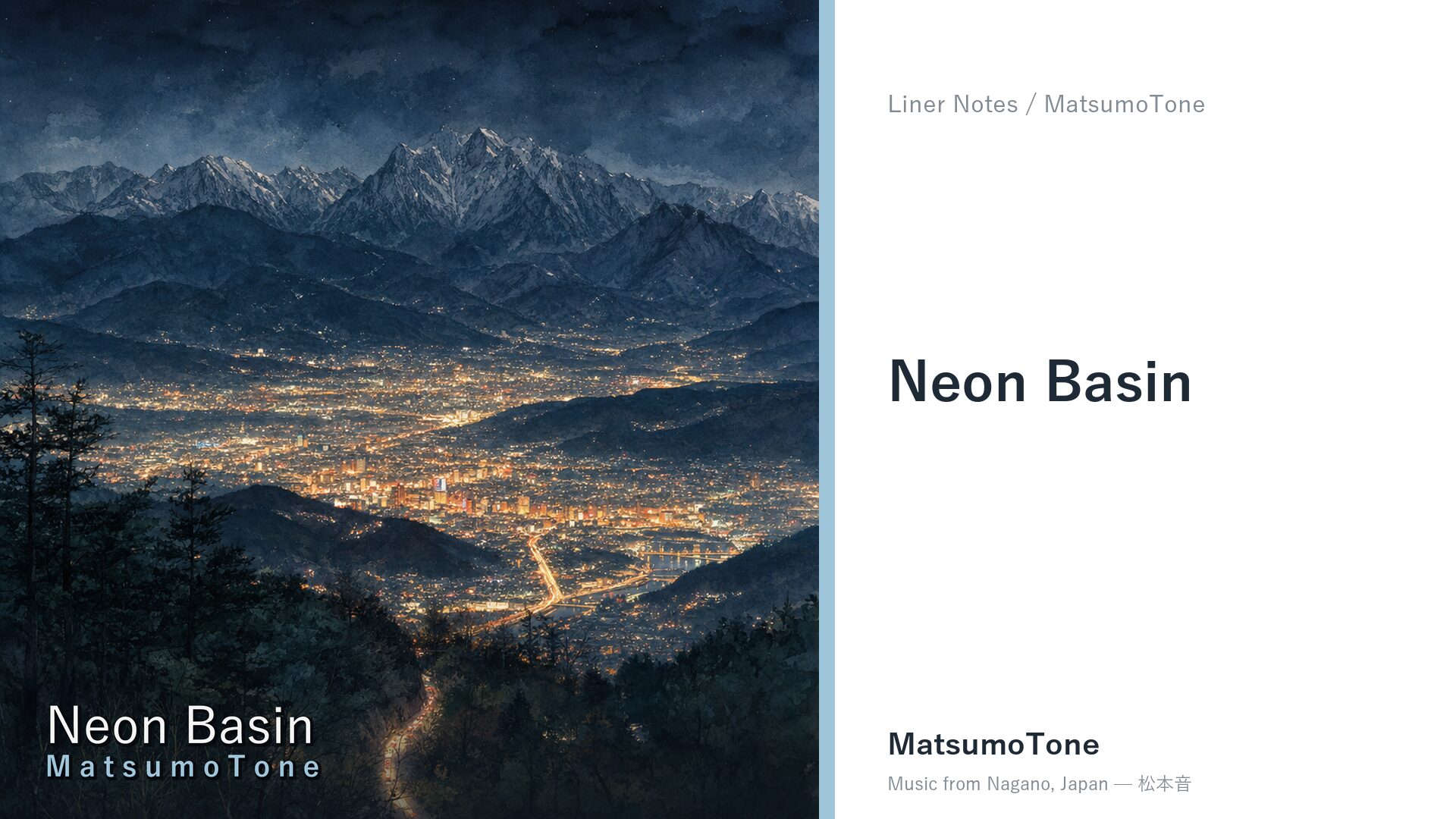
There is a place on the road down from the hills where Matsumoto stops being a name and becomes a field of light. You have been driving in the dark for a while, the forest close on both sides, and then the trees fall away and the whole basin is suddenly below you at once — a wide flat plain of amber and neon laid out across the valley floor, glittering all the way to the far western wall where the Northern Japan Alps stand black against an indigo sky. The city does not rush up to meet you. You fall toward it. Neon Basin is the four minutes of that fall.
It starts where a song about falling should start: already in the air. No fade, no count-in. At zero seconds the hook is simply there — a cool, soulful female voice, sung in Japanese, a little detached, dropping in mid-phrase: into the floor of the neon, falling; into the sea of light, falling. The voice isn’t reaching for you so much as drumming at you. Syllables snap against the backbeat like a hand-clap, hard consonants landing on two and four, open vowels stretching the line wide. It’s a melody, but it behaves like a percussion part. Underneath it a funk bass walks and pops with ghost notes, a live kit hits a hard snare, a compressed guitar chops the offbeats, and the whole thing is moving before you’ve decided whether to move with it.
Fifty years ago, Kraftwerk drew a line under an idea and called it the man-machine: the voice that is half human and half circuit, the pulse that never tires, the sequencer that breathes. What those Düsseldorf engineers were quietly reaching for under all the chrome was a collision — Teutonic precision shaking hands with African-American funk. Neon Basin lives inside that handshake. The grid is exact; the pocket is human. You can hear the family resemblance everywhere in it: the tight, fat-bottomed groove of Louis Cole, the filtered four-on-the-floor euphoria of French house, the long hypnotic patience of Underworld, where one small phrase repeats until it stops being a phrase and becomes a place.
And if I’m honest — and this blog is nothing if not honest about how the sausage is made — there are two more ghosts in the room. Somewhere in the chord turns you can feel Dua Lipa’s Levitating, that frictionless nu-disco glide. And underneath the melancholy of the changes, sitting where it has sat in my ear since 1998, is Utada Hikaru’s Automatic — the cool, descending R&B harmony that taught a whole generation in Japan that pop could be sad and sleek at the same time. Neon Basin didn’t set out to quote them. It drifted toward them, the way water finds the low ground, because they are the gravity wells of exactly this feeling: Western disco light meeting Japanese R&B shadow. The trick, the only trick that matters, is to borrow the vehicle and keep your own fingerprints — and to know which one you’re doing.
Disco at its purest is one hundred percent light. Neon Basin is not, and that is the whole point of it. Behind the lit plain, all the way up the far side of the valley, stands the unbroken wall of the Northern Alps — one sharp asymmetric peak in the center, a jagged ridge of uneven snow-streaked summits on either side, cold blue-grey rock under a deep night sky. It does not glitter. It does not move. It watches.
The song knows the mountain is there. In the bridge the groove pulls its hand back. A single detuned tone bends sour underneath; a dark mountain-drone rises; for a few bars the euphoria simply drains out and something uneasy stands in its place — the mountain is black, the city burns, hold your breath, and run — and then the beat slams back and the descent resumes, faster, a guitar solo thrown up out of the open window like an arm into the night air. That two-second tug of dread under the dancing is not an accident. The brightest electric night in Nagano is happening at the foot of something vast, cold, and indifferent, and I want you to feel both at once. Call it the canary’s instinct: the small bright thing singing in front of the immense dark, half celebration, half warning. In the age of the machine, it’s the most honest feeling I know how to fold into something you can dance to.
Here is the part I only fully understood after this track was finished, and it has quietly reorganized everything I think this project is.
MatsumoTone is Matsumoto plus tone. In Japanese it reads as “the sound of Matsumoto.” I chose the name because I make music here, about here. What I had half-forgotten is that Matsumoto is, almost secretly, one of the great guitar-making towns of the world. FujiGen, founded right here, built the instruments that carried Fender and Ibanez through their Japanese golden age. Matsumoku, a woodworking factory a few streets over, made the guitars that wore the Aria and Epiphone and Westone names. And out of that same ecosystem came Maxon — the company whose pickups went into those guitars, and whose green overdrive pedal, sold under the Ibanez name as the Tube Screamer, went on to shape the electric guitar sound of half the records you love.
So the name was more literal than I knew. Matsumoto is a place that has, for generations, manufactured tone. The hills I’m driving down in this song look out over factories that taught the world what a Japanese electric guitar feels like under the hands. MatsumoTone — the sound of Matsumoto — turns out to mean exactly what it says.
Neon Basin was generated, then taken apart into its separate stems and rebuilt by hand: the voice lifted so it rides the groove instead of fighting it, the low end kept dead-center and mono so the bass stays a fist and not a smear, guitars and keys opened out to the sides so the night has width, and a final transparent master that leaves the dynamics alone — because a song about falling into light should breathe, not clench.
And here is the honest edge of it. For all that, the machine still can’t quite reach the density and the polish of a record cut by hands in a room. You can hear the gap. I’ve started to hear it everywhere. Which is why the next chapter of this project is already obvious, and it’s the most appropriate possible answer to the gap: real bass, real guitar, recorded properly, routed through the kind of tone that Matsumoto has been building all along. The man-machine has had its machine half for a while now. It’s time to put the human hand back on the strings — in the town that makes the strings.
MatsumoTone is built in the open. Here is exactly how Neon Basin was grown.
Engine: Suno · Voice: Female, sung in Japanese · BPM: ~112 · Weirdness: 28% · Style Influence: 82%
Style prompt:
Starts on the chorus hook at 0:00, no fade: a catchy soulful female lead sung in Japanese, cool and detached, the voice used as a percussive rhythm instrument, syllables syncopating against the backbeat, carrying a riff-like topline over a funky bass riff with ghost notes and pops, a live acoustic drum kit with a hard backbeat, the snare on beats two and four, and a compressed funk guitar chop. Modern nu-disco R&B, 112 BPM, no live audience, no crowd. The groove stays Western funk, never J-pop: a static funk vamp, no key change. Each chorus builds, the final the peak with stacked backing vocals and ad-libs; the chorus fills with vocal, funk guitar, bass, keyboard and a light vocoder accent blending warmly, the verses strip to bass and drums with space. A funky guitar solo in the break. A faint granular machine-breath ear-candy. No 808, acoustic kit only. One detuned undertow and a dark mountain-drone in the bridge, the groove pulls back then returns hard. Analog warmth, tape and plate.
Excluded: crowd noise, cheering, applause, 808 drums, J-pop, idol pop
Then the stems were pulled into Ableton Live, balanced by hand, and finished through iZotope Ozone — kept transparent on purpose.
Sung in Japanese. Original, romanization, and English.
[Hook] ネオンの底へ/落ちてゆく/光の海へ/落ちてゆく Neon no soko e / ochite yuku / hikari no umi e / ochite yuku Into the floor of the neon, falling — into the sea of light, falling
[Verse] 山を越えて/灯が見える/谷の奥で/街が呼ぶ Yama o koete / akari ga mieru / tani no oku de / machi ga yobu Over the mountains, the lights appear; deep in the valley, the city calls
[Pre-Chorus] 下りてゆく/光の中へ Orite yuku / hikari no naka e Going down, into the light
[Verse] 窓を開けて/風になる/夜の色に/溶けてゆく Mado o akete / kaze ni naru / yoru no iro ni / tokete yuku Open the window, become the wind; into the color of night, dissolving
[Bridge] 山は黒く/街は燃える/息をひそめて/また走る Yama wa kuroku / machi wa moeru / iki o hisomete / mata hashiru The mountain is black, the city burns; holding my breath, I run again
[Verse] 赤と青の/ネオンサイン/アクセル踏んで/加速する Aka to ao no / neon sain / akuseru funde / kasoku suru Red and blue neon signs; foot on the gas, speeding up
[Hook / Outro] ネオンの底へ/落ちてゆく/どこまでも/落ちてゆく/光の海へ/落ちてゆく Neon no soko e / ochite yuku / doko made mo / ochite yuku / hikari no umi e / ochite yuku Into the floor of the neon, falling — on and on, falling — into the sea of light, falling
Neon Basin is the first release in an ongoing man-machine series from MatsumoTone: Nagano songs built where the live hand meets the electric grid. Put it on after dark. Ideally, put it on moving.
Neon Basin is available on all major streaming platforms. Hear the full release on Spotify, Apple Music, Amazon Music, and everywhere else.
Drive down into it.
The whole thing began as one paragraph of text. Not notation, not a demo — a paragraph. What follows is that paragraph. Read it as a seed and not a blueprint: the generator wandered, I went back in with a bass line and a re-tracked guitar, and the record you just heard is the argument between the two. The text is still where the light first came on. Paste it into Suno’s Styles field, set the dials, and you start where I started.
Settings. With lyrics · Weirdness 28% · Style Influence 82% · Title, Neon Basin.
Starts on the chorus hook at 0:00, no fade: a catchy soulful female lead sung in Japanese, cool and detached, the voice used as a percussive rhythm instrument, syllables syncopating against the backbeat, carrying a riff-like topline over a funky bass riff with ghost notes and pops, a live acoustic drum kit with a hard backbeat, the snare on beats two and four, and a compressed funk guitar chop. Modern nu-disco R&B, 112 BPM, no live audience, no crowd. The groove stays Western funk, never J-pop: a static funk vamp, no key change. Each chorus builds, the final the peak with stacked backing vocals and ad-libs; the chorus fills with vocal, funk guitar, bass, keyboard and a light vocoder accent blending warmly, the verses strip to bass and drums with space. A funky guitar solo in the break. A faint granular machine-breath ear-candy. No 808, acoustic kit only. One detuned undertow and a dark mountain-drone in the bridge, the groove pulls back then returns hard. Analog warmth, tape and plate.Treat the key and tempo as intent, not as measurement. Half the pleasure is hearing where it refused to go.
Some streaming links on this site are affiliate links. See our Affiliate Disclosure for details.