Neon Basin
MatsumoTone
MatsumoTone

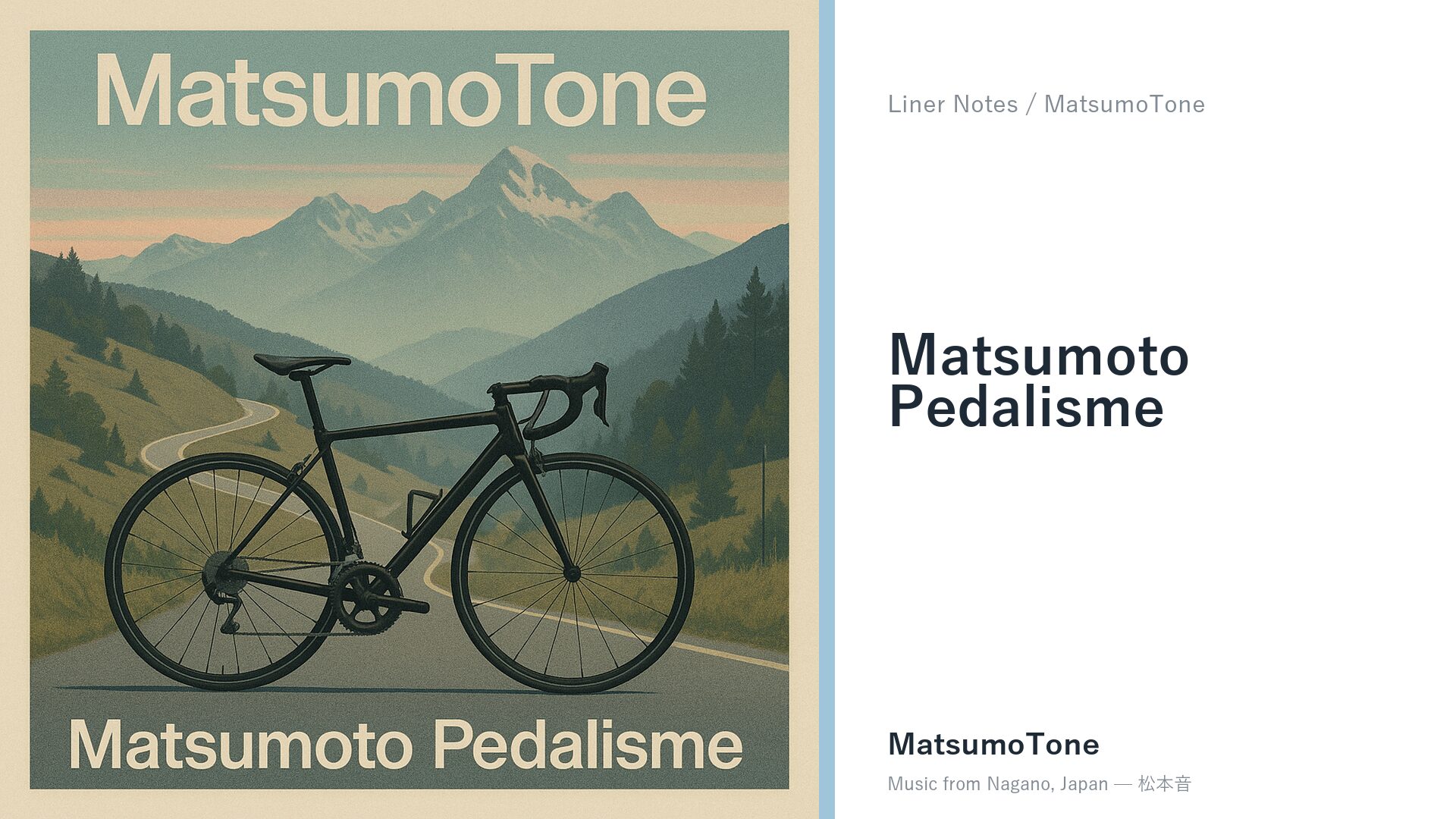
Two of the steepest road-cycling events in Japan happen in Nagano each summer. The first is the Tour de Utsukushigahara in July, a climb to the 2,034-metre plateau east of Matsumoto. The second is the Norikura Hill Climb in August, a 20.5-kilometre ascent to Tatamidaira at 2,716 metres, the highest paved road in the country. Both events belong to the same overlapping set of riders, and to the same set of mountain weather.
Matsumoto Pedalisme is the fourteenth MatsumoTone release, a concept album of six pieces inspired loosely by the structural idea of Kraftwerk’s Tour de France Soundtracks (2003) — analog synthesizers, vocoder hum, bicycle field recordings, four-on-the-floor pedalling grid — applied to the two specific Nagano climbs above.
A long cycling climb is one of the few sports whose internal rhythm is genuinely close to a sequencer. The pedal stroke is metric. The breath is metric. The gear change happens at predictable intervals. The body becomes, for an hour, a small mechanical device producing wattage at a steady cadence. The 1970s Düsseldorf-school electronic minimalism that inspired this album was, famously, music written by humans imagining themselves as machines. A long mountain ride is the closest a human body normally gets to that imagined state.
The instrumentation is intentional in this regard. Minimoog mono lead. Polymoog chord pad. Vako Orchestron string and choir pad. Prophet-5 sequencer. Synthi AKS noise. A TR-808 or LM-1 drum machine on the four-on-the-floor pedal grid. Vocoder humming open vowels — ah, oo, ee — over the top, no language. The bicycle itself is in the recording: chain rotation, the click of a freewheel, the noise of a gear shift.
1. Prologue: Matsumoto Plain — 88-92 BPM. A warm-up ramble across the Matsumoto Plain before either climb begins. A minor moving to C major. Distant chain, a single breath, dawn over the alps.
2. Utsukushi Étape — 122-126 BPM. The rolling pedal phase of the Tour de Utsukushigahara. E minor moving to B minor. Chain rotation and freewheel ratchet as constant percussion.
3. Utsukushi Chrono — 136-140 BPM. The time-trial section near the top of the plateau. D Phrygian — the only Phrygian piece on the album, chosen for the small inward menace of its second degree. Breath becomes audible. The sprocket clicks against the cassette.
4. Norikura Étape 1 — 108-112 BPM. The climbing pace from the Sanbon-daki falls trailhead toward the cold spring. G minor moving to B-flat major. Wind shear against the head.
5. Norikura Étape 2 — 94-98 BPM. The struggle phase near Kuraigahara toward Tatamidaira. B-flat minor moving to D-flat major. Heavy breath. The gear grinds against itself. This is the longest sustained climb in Japanese road racing, and the slowest piece on the album by intention.
6. Régéneration — 70-74 BPM. The recovery, in a small Shirahone Onsen onsen the same evening. C major, the warmest key. Distant crowd cheers fade. The body is no longer a machine. The album resolves.
Movement through Matsumoto as compositional source is part of the wider MatsumoTone aesthetic — see the concept piece.

The vocoder hum is wordless on purpose — open-vowel only, no syllable that could be read as a language. This is partly an aesthetic choice and partly a structural one. A cyclist climbing for an hour does not have breath for words. The vocoder is the body’s continuous output. If you find yourself wanting words inside the hum, the album is doing its job.
A stationary jazz-funk counterpart at street level: Matsumoto Boulevard 1976.
There is an obvious objection to the album’s central pairing: bicycle racing is one of the most physically intense and unstructured sports, and analog electronic music — slow envelopes, fixed oscillator tunings, modular patches that change over minutes rather than seconds — is one of the slowest and most rigorously structured musical forms. The two would seem to belong to opposite domains of human activity. The album proposes that the opposition is illusory once the time scale is extended. A hill climb is not a sprint; it is a forty-minute to two-hour exercise in metering an unchanging effort over a slowly changing gradient. Analog electronics, similarly, are not about fast events; they are about the slow modulation of fixed sources. Both forms reward sustained low-bandwidth attention. Both forms punish over-reaction. The two map onto each other once they are both viewed at the time scale of the actual climb.
The instrument palette is deliberately restrained: an ARP Odyssey, a Roland System-100, a small modular setup built around Doepfer and Mutable Instruments modules, and a single Roland TR-808 used sparingly for percussive accents. No DAW automation is used to fake real-time interaction — every patch change happens on a knob, with audible interpolation. The result sounds, in the long form, more like an acoustic ensemble than like a typical electronic record. The instruments speak through the player rather than through the sequence.
Two specific Nagano hill climbs are referenced in the song titles and structural form. The first is the climb from Matsumoto city centre out to the Utsukushigahara plateau, a roughly 26 kilometre ascent gaining 1,600 metres of elevation — a hill climb that locals categorise as hors-catégorie in the European cycling sense. The second is the climb from Kamikochi access road junction up toward the Sawando transition zone, a shorter and steeper ascent that demands a different metering strategy. The two climbs require different physiologies, and the album’s two halves give them different sonic treatments. The Utsukushigahara climb is rendered as a long single arc; the Sawando climb is rendered as a series of shorter intensified passages.
Listeners who have ridden either climb will recognise specific gradient features in the music. The brief flat at roughly the 10 km mark of the Utsukushigahara climb appears in the first half as a sudden tempo plateau. The double-step rise just before the Sawando summit appears in the second half as a stacked-octave riff that recurs twice with a short rest between. None of these features are described in the song titles, but they are present in the structure for any listener familiar enough with the routes to find them. The album rewards local knowledge without requiring it.
The neologism in the title — pédalisme with a Japanese reframing — is a deliberate borrowing from the French cycling lexicon, where the noun denotes the specific quality of a rider’s pedalling cadence: smooth or jagged, high-cadence or grinding, even or asymmetrical. A coach in France might say that a particular rider a un bon pédalisme. Applied to music, the term names the album’s actual subject: not the climb as event, but the cadence as quality. The pieces here are studies in cadence — in how a sustained physical effort can be made musical by attending to its rhythmic micro-structure.
An analog modular patch has a cadence in the same sense that a rider has a cadence. The patch’s voltage-controlled oscillators drift slightly in pitch over time; its filters open and close on slow envelopes; its sequencer ticks through its steps at a tempo that, even in 2026, is rarely perfectly stable. The same is true of a rider on a long climb. Their heart rate fluctuates within a narrow band. Their breath cycles through stable patterns that nevertheless shift over the course of the climb. Their pedal stroke has a characteristic asymmetry — the down-stroke is stronger than the up-stroke, the right leg is usually slightly more powerful than the left, the foot’s angle at the bottom of the stroke changes as the climb steepens. None of these fluctuations are visible to a casual observer. All of them are audible to someone who has spent time inside the rhythm.
The album’s compositional method foregrounds these small fluctuations. The oscillators are intentionally left slightly detuned. The sequencer’s tempo wavers by fractions of a beat. The filter envelopes do not always reach their full open position before the next note. A clinical listener will hear instability and call it a fault. A listener who has ridden long climbs will hear the same instability and recognise it as the actual sound of a body sustaining effort over a distance.
Some music is designed to be listened to in stillness. Some music is designed to be listened to during specific kinds of movement. Matsumoto Pedalisme belongs to the second category, more specifically still: it is designed for the rare listening posture of a stationary trainer at home, the kind of cycling that an enthusiast does on rollers or a smart trainer during the months when the actual roads are unrideable. That posture has no scenery, no traffic, no weather; the body produces the same effort as on a real climb, but the environment supplies none of the usual external rhythms. The album fills that environmental gap. It supplies, in audio form, the cadence and the duration that the empty room cannot.
Listeners who do not ride will still find the album coherent — the analog electronics tradition has a long history of being listened to for its own sake — but the album’s optimal use case is the trainer-bound winter rider. For such a listener, the album functions less as music in the ordinary sense and more as a kind of patient external pacemaker, sitting in the room and reminding the rider that other long sustained efforts have a sound, and that the rider’s own effort is part of a larger lineage.
A listener who has never ridden a long climb may wonder whether this album is accessible to them at all. It is. The album’s analog electronics tradition has its own audience, and the cycling subject is offered as a structural metaphor rather than as a precondition for entry. A listener with no cycling background can hear the album as a study in sustained slow modulation — the same way they might hear any other analog modular release. The cycling layer simply provides one additional reading of the same music. Both readings are intended. The album does not require the cycling reading to function, but it rewards listeners who hold both readings simultaneously.
The album was sequenced for end-to-end listening but each piece is also self-contained and can be played in isolation. The second piece in the sequence is the most representative of the album’s overall sound and is the recommended single point of entry for new listeners. The fifth piece, by contrast, is the most experimental and should be approached only after the album’s general patch vocabulary has become familiar through the earlier material. There is no requirement to listen in order; the cyclic nature of climbing favours non-linear playback.
Matsumoto Pedalisme is available on all major streaming platforms. Hear the full release on Spotify, Apple Music, Amazon Music, and everywhere else. Loud is acceptable; a slight wind in the room is recommended.
Cycling music has to breathe at the rate a body breathes, so this paragraph is written in cadences rather than in bars. Take it as a seed, not a spec: what came back climbed differently than I expected, and I kept the better climb. The gradient, though, was written here. Paste it into Suno’s Styles field, set the dials, and push off from the same place.
Settings. With lyrics · Weirdness 30% · Style Influence 75% · Title, Prologue Matsumoto Plain.
Analog electronic minimalism Prologue dawn ramble 88-92 BPM, A minor to C major modulation, 1980s Düsseldorf-school analog synth-pop with vocoder hum. Industrielle Volksmusik morning, vintage shortwave radio atmosphere, retro-futurist. Polymoog chord pad slow attack A minor triads. Prophet-5 analog sequencer locked steady eighths, hypnotic repetition. Vako Orchestron string pad sustained mist. Minimoog mono lead sparse phrases. Synthi AKS slow filter sweep. TR-808 style drum machine soft kick 1 and 3, hi-hat closed eighths, no snare, Teutonic precision. Vocoder humming wordless ah-ooh-ee throughout, female-neutral, man-machine partnership. Alltagsmusik field recording: distant bicycle chain, soft breath, dawn fog, street lamp hum. Pristine electronic synthesis, clean mastering analog warmth, Kling Klang aesthetic. Tags: 1980s German analog electronic, synthwave, krautrock minimalism. Structure: pad intro, sequencer entry, vocoder layer, lead, fade.This is the opening piece. The other climbs were mapped the same way.
Tempo here is cadence, and cadence is a body, not a metronome. It took lines I would not have taken, and some of them were faster.
Some streaming links on this site are affiliate links. See our Affiliate Disclosure for details.