Why MatsumoTone — Music as a Field Recording of Place

Most music projects are anchored to a person. MatsumoTone is anchored to a place.
The place is Nagano — a mountainous prefecture in central Japan, west of Tokyo, far enough inland that the climate is cold and dry in winter and the summer air feels older. It is a region defined by altitude and water. The Japanese Alps run through its spine. Rivers carry snowmelt down into rice paddies. The old Nakasendo highway used to thread post-towns through its valleys, and a few of those towns are still walking distance from where you can buy coffee.
Nagano contains Kamikochi, where the British missionary Walter Weston put modern alpinism on the map in the 1890s. It contains Karuizawa, where Tokyo intellectuals built summer cottages a hundred years ago and still do. It contains the lake at Suwa, where the winter ice forms long sacred ridges that locals once read as omens, and where a fireworks festival now reflects upside-down in summer water. It is, by almost any measure, one of the most musically suggestive places in Japan.
This project is an attempt to write down what that place sounds like. (For more on who is behind it, see our about page.)
Why I started
The honest answer: I live in Matsumoto, and Matsumoto is a music city that almost no one outside Japan has heard of.
This is the home of the Seiji Ozawa Matsumoto Festival (formerly Saito Kinen) — a summer festival that has, since 1992, brought together principal players from the Berlin Philharmonic, the Vienna Philharmonic and other major orchestras to perform here for two weeks every year. It is also the birthplace of the Suzuki Method of violin teaching, founded here by Shinichi Suzuki and now used in over forty countries. The surrounding Matsumoto-Azumino plain remains one of the centres of Japanese acoustic-guitar building.
And every September, the city hosts Ringo Ongaku Sai (the Ringo Music Festival) — an outdoor rock and indie festival held at Alps Park, running since 2009, that draws some of the most respected Japanese popular-music acts. Matsumoto is not only a classical city; it is a music city in the round.
I am not a trained composer. I have no claim to that lineage. But I live next to it, and I wanted to find one small way to point at it from the outside — for listeners who would otherwise never know it was here. MatsumoTone is that small way.
A track is a place, a season, an hour
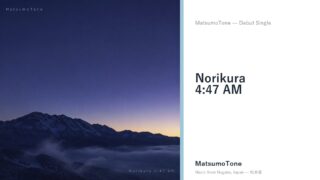
Every MatsumoTone track is built around three coordinates: a specific location, a specific season, and a specific time of day. The first album opens with Mount Norikura at 4:47 in the morning — the half hour before alpine dawn, when the cable car has not started running yet and the only sound on the ridge is wind through dwarf pine. Another album spends six tracks inside the 1973 resort season: Karuizawa station in early summer, Suwa Lake fireworks on a humid August night, a tea room in old-town Karuizawa in late autumn, snow on the same town in early winter. The seasons rotate; the location anchors.
The simplest editorial rule we have is this: never write a track that could happen anywhere. If a piece could be transplanted to Yosemite or Kyoto or the Adirondacks without losing anything, it is not a MatsumoTone track. The place has to be load-bearing.
Why liner notes
The music itself is wordless. Most tracks are instrumental — piano-led soft-rock under the long shadow of the early seventies, jazz-funk that learned its phrasing from the Tokyo studios of 1976, modern modal guitar that owes a debt to the workshops where Nagano luthiers still build instruments by hand. None of that needs explanation. You can listen on the train and never read a word.
These liner notes exist for the listener who wants to know where. Which valley. Which lake. Which post-town. What was happening there in 1973. Why there is a cassette tape on the album cover. That kind of curiosity is the entire reason this site exists. Each post takes one track, plants it in its geography, and gives you the small histories that the music itself cannot say out loud.
You can listen without reading. You can read without listening. Or you can do both — which is, honestly, what we hope you do.
What is already in the catalog
A short, incomplete list of what has already been released:
- A pre-dawn alpine ascent on Mount Norikura.
- A long-form study of the late-summer light field on the same mountain.
- A six-track resort cassette set in 1973, moving from early-summer Karuizawa to first-winter snow.
- A pilgrimage suite in five ragas, tracing a south-bound walk through Shinshu.
- A boulevard-jazz set in 1976 Matsumoto.
- An ambient stillness piece for Kamikochi at the bookends of the day.
- A snowmelt suite for the valleys west of the prefectural capital.
More are on the way. Fourteen albums are in motion as of this writing, with a steady drip of new ones planned through the year. Each release adds another coordinate to the map.
The listener this music is built for
Most ambient and modern-classical music sells itself as background — something to put on while you concentrate, or while you sleep. MatsumoTone is built for a narrower listener than that. The implied audience is someone who can sit for thirty minutes with a single album, who likes knowing where a piece was written, and who is willing to look up a place name on a map before pressing play.
That listener does not have to live in Nagano, or in Japan, or have ever stood on a mountain ridge before dawn. But they have to be the kind of person who finds the difference between an alpine 4:47 AM and a city 4:47 AM worth thinking about. Some of the music makes sense if you only carry that curiosity loosely. Most of it makes much more sense if you carry it deliberately.
If you are a working musician, an environmental writer, a long-distance walker, a city dweller who saves up for one mountain trip a year, a former Nagano resident now somewhere else, or simply a quiet person who wants their morning kitchen to feel like an alpine plateau for half an hour — this catalog is for you. If you want music that gets out of the way, there are better options.
What this label does not do
Defining the label by what it omits is sometimes more useful than defining it by what it does. This label does not release singles in the contemporary streaming sense — short tracks designed for playlist insertion. It does not release albums whose track titles are optimised for search. It does not release music aligned with seasonal commercial events except where the music’s own subject naturally coincides with one. It does not maintain a public social media presence calibrated for engagement metrics. It does not pursue cross-promotion with adjacent contemporary artists. It does not seek mainstream press coverage. It does not court festival booking. None of these abstentions are absolute; each is a default that can be reconsidered for a specific case. The default is, however, abstention.
These choices are made because the label’s underlying premise — music as a long-form field recording of a specific place — requires the listening conditions that contemporary commercial music marketing actively destroys. A short attention span is incompatible with a forty-minute drone piece. A playlist-shuffled listening session is incompatible with album sequencing keyed to specific hours of a specific day. Social engagement is incompatible with the kind of long quiet relationship the label is asking listeners to build with each release. The label’s apparent passivity in commercial terms is itself the precondition for the music being able to do what the music is for.
Who the label is not for
The label is not for listeners looking for new music in the sense in which most music-discovery infrastructure uses the word. Listeners arriving from algorithmic recommendation systems, looking for the next thing to fill thirty minutes of background sound while doing something else, will typically find the catalog disappointing. The albums are too quiet, too long, too geographically specific, too dependent on the listener’s willingness to make the music part of an actual environment rather than an actual playlist. This is not a critique of those listeners; it is simply a description of the demographic mismatch. The label is for a smaller audience, one that already has a tendency to relate to music as place-bound and time-specific. That audience is small, but it exists, and the catalog is in correspondence with it.
A practical note for new arrivals
Listeners arriving at the catalog for the first time are encouraged to begin with one specific album whose subject most matches their current physical environment. A listener at sea level in a city should start with the city-pop album or the post-punk castle-town album. A listener at altitude or near mountains should start with one of the alpine drone or solo guitar albums. A listener near water should start with the snowmelt suite. The catalog is not designed to be entered in chronological release order; it is designed to be entered at whichever album most resembles the listener’s actual current place. Each album then leads naturally into its geographical neighbours.
Closing note
The label’s catalog will continue to grow slowly. New releases are added when a specific place, hour, and instrumental configuration align in a way that warrants treatment at album length. There is no release schedule. There is no scheduled return to any specific catalog gap. Listeners who have followed the catalog from its first release are encouraged to read this open-ended approach as the label’s commitment to itself rather than as a lack of plan. A field recording of a place takes the time it takes.
How to listen
MatsumoTone is distributed worldwide. The full catalog is available on Spotify, Apple Music, Amazon Music, YouTube Music, Tidal, Deezer, and most other major platforms. Pick whichever one you already pay for.
The most direct streaming links sit at the bottom of every track post. For an overview of everything, the simplest path is to search MatsumoTone on Spotify (or on the platform of your choice) and follow the artist page.
The best way to use this site is to read a liner note, click through to the track, and let it play while you look up the place on a map. That is the closest thing to actually being there.
For the solo-guitar morning recording that began the project, see the Norikura 4:47 AM post.
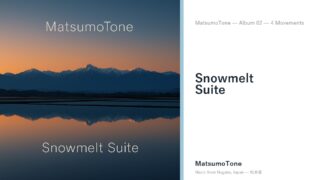
For the modern-classical water suite tracing snowmelt from peak to estuary, see the Snowmelt Suite post.
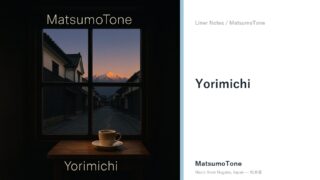
For the four-detour jazz-ambient day-in-Matsumoto framing, see Yorimichi.
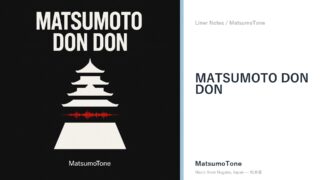
For the festival-anthem reframing of regional ritual, see MATSUMOTO DON DON.
Listen on your platform
Streaming links to specific releases will be added below each individual track post. For now, please search MatsumoTone on your preferred service.
Some streaming links on this site are affiliate links. See our Affiliate Disclosure for details.