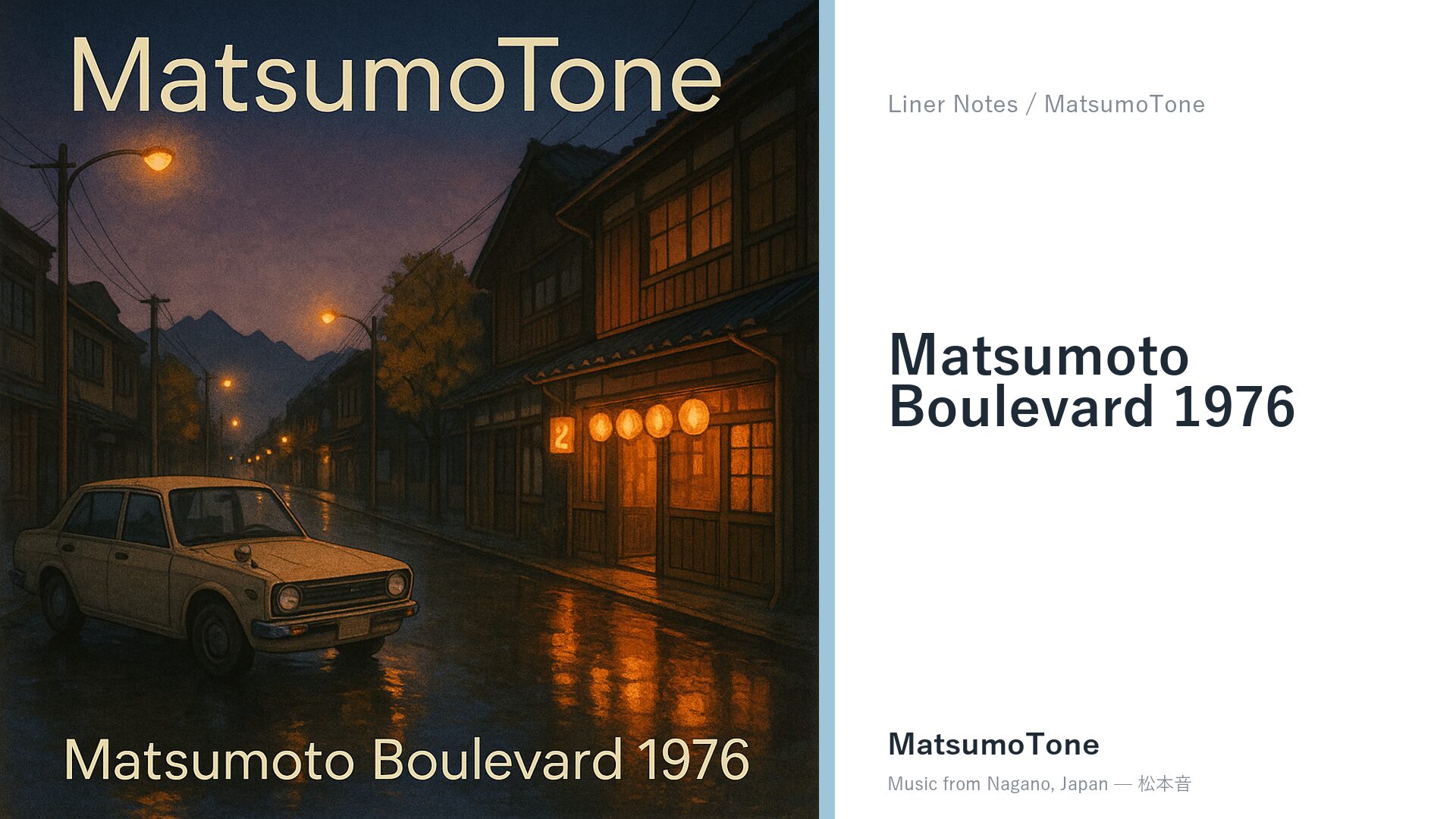
Matsumoto Boulevard 1976 — Six Pieces from a Lost Year of Showa Jazz-Funk
MatsumoTone
MatsumoTone

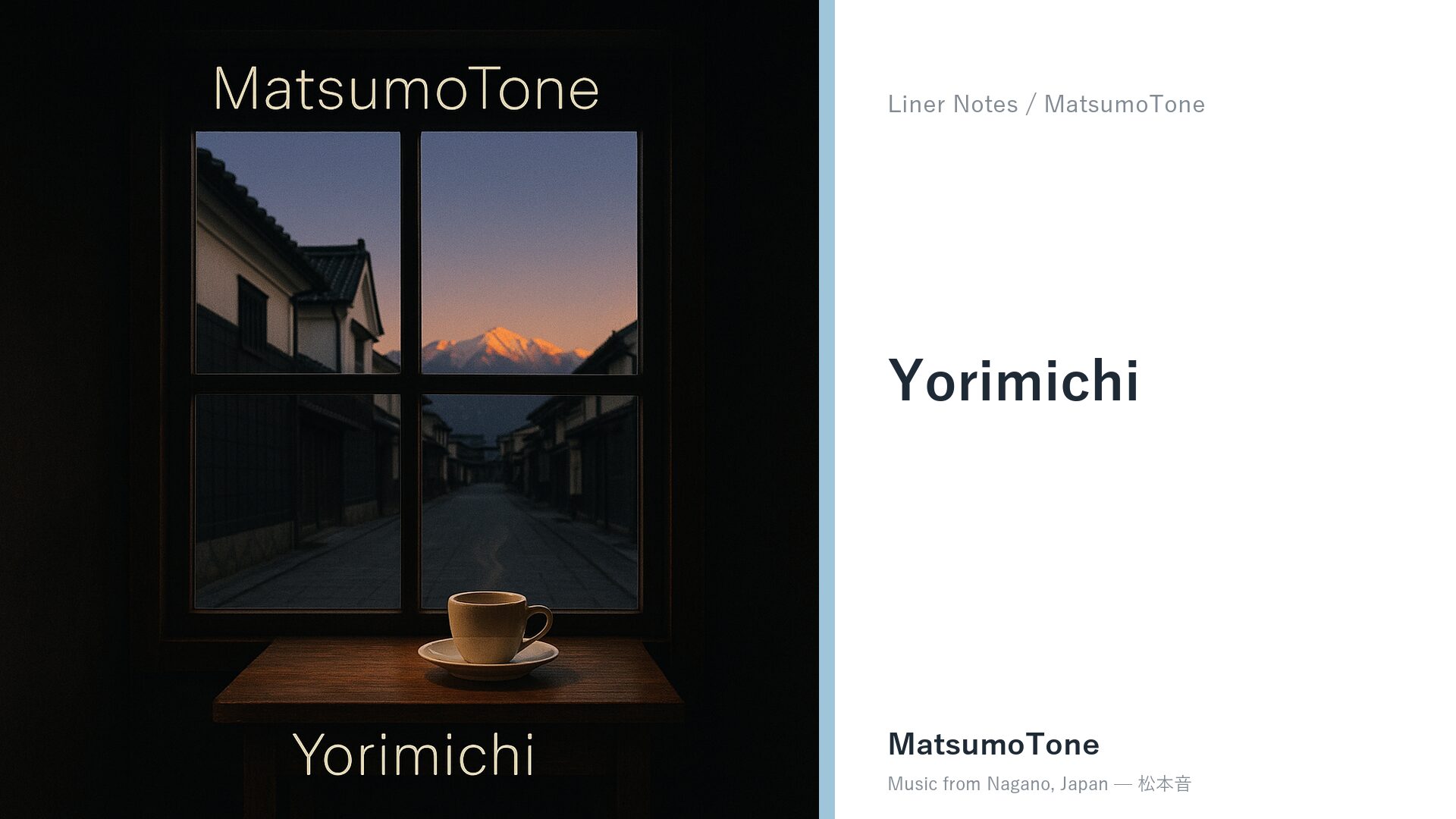
The Japanese word yorimichi is hard to translate. It is not a detour in the English sense of inconvenience — a road closed, a bridge out, a reroute. It is closer to a chosen small wandering. You meant to go straight home, but you turned left into the alley because the coffee smelled good. That is yorimichi.
Yorimichi is the second MatsumoTone mini-album. Four piano-trio pieces, about seventeen minutes in total, tracing one day inside the small detours of Matsumoto.
Nagano Prefecture sits near the northern edge of Japan’s old jazz-kissa (jazz coffee shop) belt. The kissaten on Nakamachi and Nawate-dori still play Bill Evans in the late afternoon, the same way they did in 1972, and Brad Mehldau in the same rooms today. You walk in, order a coffee, and an upright bass figure is already running underneath the conversation.
This album was written from inside those rooms. Piano trio, brushed drums, an upright bass walking in the middle distance — the standard furniture of a contemplative jazz café. Where Snowmelt Suite drew the natural cycle of the alps, Yorimichi draws the human cycle of a day in town. The structural counterpart: water going downhill versus a person walking a small circle and arriving home.
1. Nawate Morning — 8 a.m. at the kissaten on Nawate-dori, the frog-statue street along the Metoba river. The piano enters in F major like someone unfolding a newspaper. A short head, a relaxed piano solo, and you are out the door again.
2. Kura Town Bossa — early afternoon on Nakamachi-dori, the street of black-plaster storehouses. A subtle shaker enters, the key turns to D minor, the tempo slips into a slow bossa. The light between the kura is sharp and cool; the music is the shadow underneath it.
3. Joyama Sunset — late afternoon on the Joyama hill, looking down on Matsumoto Castle with the Northern Alps behind it. A tenor saxophone joins the trio. The harmony lifts to B-flat major — the IV of F, a widening. This is the longest piece on the album and the only one with a horn. It needs the width.
4. Asama Onsen Closer — late evening, soaking at Asama Onsen. A faint Rhodes pad drifts in underneath the piano. The key returns to F major, closing the circle that opened at 8 a.m. The album ends where it began, slightly warmer.
MatsumoTone treats each album as a recording of a specific place — the concept is set out here.

The word yorimichi does not translate cleanly. The closest English equivalents — detour, side trip, roundabout — all imply a deviation from a more important route. In Japanese the word carries no such moral weight. To take a yorimichi is simply to admit that the journey itself is the substance, and that the destination is the smallest part of it. The classical Japanese aesthetic of ma — the meaningful interval — sits inside this word. Most of life happens in the detour, not at the arrival.
This album is an attempt to give that idea a shape in jazz form. Four short pieces, each one a deviation from the line a tourist would draw between any two landmarks in the city. The trio plays as if it has all afternoon and nowhere particular to be. The piano takes the lead because the piano can carry both the melodic line and the implicit floor, and a detour needs a floor under it — somewhere to return to once curiosity has been satisfied.
The upright bass on the second track sits a little behind the beat in a way I am not entirely sure I meant. It works for the kura-town shadows — slightly off, slightly tired — but if I were doing the take again I would lean it forward two milliseconds. The piece is what it is. A detour is allowed to be slightly off.
A nocturnal companion piece to these daytime detours: Matsumoto Night Cassette.
Matsumoto is a small city by capital standards — roughly 240,000 residents, no skyscrapers, a single river through the old quarter, an alpine wall to the west that turns pink before sunset. Most of the streets in the central five-minute walk can still be walked at the pace a piano trio might naturally swing at. The album was built around that pace. None of the pieces hurry. None of them are designed for headphones on a commuter train.
Each of the four detours has its own colour because each location has its own colour. A quiet shrine garden in the late morning, a covered market street with its rolling shutters half-pulled, a narrow river bend lined with willow trees, a side staircase up the eastern slope that nobody photographs. The trio reads each of those settings with a slightly different touch — brighter ride cymbal here, a thicker left hand on the piano there — but never abandons the underlying form. The form is: walk, pause, notice, continue.
A piano trio is the smallest standard jazz group in which all three roles — melody, harmony, rhythm — are explicit. There is no horn for the melody to hide behind, no guitar to fill the harmonic middle, no second percussionist to widen the groove. Every gesture is exposed. For music whose subject is small-scale attention, this exposure is the point. Adding a fourth voice would dilute the conceit; subtracting any of the three would collapse it. The trio is the smallest unit that can render a city’s textures without reducing them to a sketch.
The post-bop piano trio tradition — Bill Evans, Keith Jarrett’s standards trio, Brad Mehldau, Esbjörn Svensson — established a way of treating standards and originals at a slow, conversational pace, with the bass and drums as equal melodic voices rather than as rhythm-section accompaniment. This album takes its pace from that lineage. The pieces do not solo over chord changes in the bebop sense; they breathe through them. A single bar can hold an entire phrase from each of the three instruments without crowding.
What is locally specific is the choice of what to walk slowly through. American piano trios tended to walk slowly through standards from the Great American Songbook — songs whose lyrics referred to a New York or Chicago context. Yorimichi walks slowly through a Japanese city without ever quoting a Japanese standard. The melodies are original. The geography is the score.
There is a specific physical posture this music asks for: seated, slightly forward, half-listening, available for interruption. The album does not punish wandering attention. If the listener looks up and stops listening for a minute, the music does not change so much that they will feel they missed something. This is itself a translation of yorimichi into compositional language — the form makes room for the listener to take their own detour mid-listen.
That tolerance for partial attention is rare in jazz, which historically has trained its audiences to follow every solo gesture. The yorimichi model proposes a different contract: the album is doing something whether or not you are watching, and you are welcome to join or leave at any point. The bass holds the floor while you are away.
Within this label’s catalog, Yorimichi is the daytime piece, the one that sits opposite the nocturnal city-pop album recorded around the same station, and well below the alpine drone albums recorded on the plateaus to the west. The three together describe the city across its full daily cycle: morning detours through the central streets, late hours around the station, and the larger geographic frame of the mountains behind it. None of the three sounds like the other two. All three carry the same underlying premise — that a place is a score, and the music is one possible reading of that score.
This album is not designed for headphones on public transport. The arrangements are small enough that train noise will swallow the bass, and the dynamic range is wide enough that the quiet sections will disappear into the floor noise of any moving vehicle. Domestic playback at moderate volume is the intended environment — a single room, a single listener, an unhurried afternoon. A weekend lunch hour, a slow morning before commitments, a late-afternoon stretch when the light is changing colour. The album rewards being treated as company rather than as content.
If a listener can map any one of the four detours to a real street in their own city — not Matsumoto specifically, simply a street with a particular character that rewards slow attention — the album has done its work. The geographic specificity of the source is a starting point, not a fence. yorimichi is the universal claim. The Matsumoto setting is one local instantiation. Listeners are encouraged to walk their own city’s smaller streets while this album is playing in their head.
None of the four detour pieces on this album carries a place name in its title. This is a deliberate withholding. A piece titled ‘Kofu backstreets at 14:30’ offers the listener a single fixed image and rewards them for matching the music to it. A piece titled simply ‘Detour II’ offers the listener a structure into which their own walked street can be placed. The album works harder by saying less. Every listener brings a different second piece. The fact that the trio plays the same notes regardless is itself an argument about what music does — it provides a frame, and the frame is filled by whatever the listener’s body has been doing recently. A frame is more useful than a label, in the long run.
The trio’s parts were composed and recorded specifically to allow this kind of multi-fit. The harmonic language is open enough to suggest several emotional registers without committing to any one of them. The melodic contours rise and fall along curves that resemble many actual streets without resembling any specific one. The drums imply a walking pace without specifying a shoe type, a body weight, or an asphalt condition. The album wants to be carried, not consulted.
All four detour pieces were written specifically for this album. None are arrangements of existing standards or transcriptions of folk material. The decision to write new compositions rather than borrow established melodies followed from the album’s central premise: yorimichi is the act of going somewhere unfamiliar, and a familiar melody would have foreclosed the unfamiliarity from the first bar. New compositions, by contrast, leave the listener with no prior reference and require them to follow the music in the same way they would follow an unfamiliar street.
Yorimichi is available on all major streaming platforms. Hear the full release on Spotify, Apple Music, Amazon Music, and everywhere else.
A piano trio leaves nowhere to hide, so this paragraph is shorter and more stubborn than most of mine. Treat it as a seed and not a blueprint — the generator strayed, and the straying is half of what makes the record worth hearing. The detour itself was written here. Paste it into Suno’s Styles field, set the dials, and take the same wrong turn.
Settings. Instrumental, no lyrics · Weirdness 20% · Style Influence 75% · Title, Nawate Morning.
jazz, acoustic piano trio, upright bass with brushed drums, F major, medium swing 95 BPM, Blue Note 1960s aesthetic, morning cafe

Acoustic grand piano with upright bass and brushed drums, no other instruments. F major, 95 BPM medium swing. Setting: 8 AM in a Matsumoto Nakamachi coffee bar, wooden interior, light through paper windows. Form: 4-bar piano-bass intro (drums silent), 16-bar head A, 16-bar A prime as brushes enter, 32-bar piano solo over AABA, 16-bar head out, 4-bar outro to silence. Harmony: F major, ii-V-I cadences with rootless Bill-Evans voicings, occasional flat-III chromatic mediant for warmth. Walking bass through the solo. Brushes hold a quiet swing pulse without dominating. Wide warm stereo, gentle tape saturation, generous room reverb on piano. Dynamics soft to medium, never loud. Extended composition approximately 3 minutes 30 seconds, complete musical arc with two head statements plus one full solo chorus, avoid premature fade. Familiar yet undiscovered.
This is the opening piece. The rest of the record follows the same method, aimed at the same place.
Key and tempo mark the road, not the walking. A detour you planned is not a detour. Listen for the turns I did not.
Some streaming links on this site are affiliate links. See our Affiliate Disclosure for details.