
Snowmelt Suite — A Water Journey from 3,000 Metres to the Matsumoto Plain
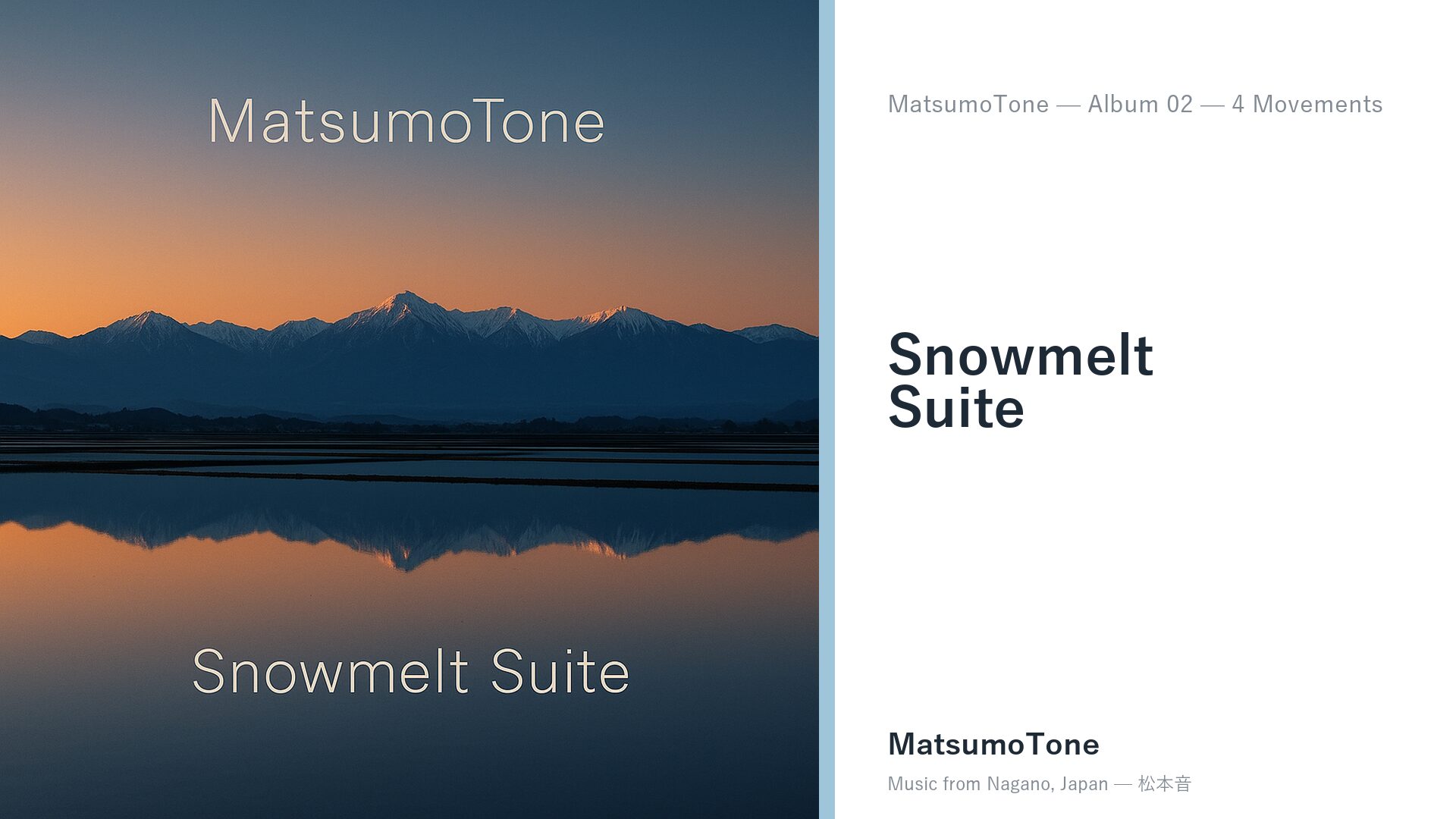
Every May, the snow that has been sitting on the ridges of the Northern Japanese Alps since November begins to melt. Water that was ice at three thousand metres in the morning is, by the same evening, running in narrow streams on the high meadows. Within a week it is in the rivers. Within a month it is irrigating rice paddies on the Matsumoto plain.
Snowmelt Suite is a four-movement album that follows that water down the mountain. Each movement marks one stage of the journey — ice on the ridge, the first thaw, the mountain stream, the rice plain at Matsumoto. The whole thing is meant to be heard as a single thirty-minute descent.
I started writing it in early May 2026, in the actual week the snowmelt was peaking. That mattered. It would have felt dishonest to make this record in January.
The geography this album actually follows
The water in this suite is not abstract. The range that holds it through winter — Yarigatake at 3,180 metres, Hodakadake at 3,190 metres, Mount Norikura a little further south at 3,026 metres — is a continuous spine of stone running north to south along the western edge of Nagano. The snow that sits on those ridges from November onward is the reservoir.
When the thaw begins, usually in the second or third week of May, the meltwater takes two paths down. The first is overland: it pours off the rock, runs through the dwarf-pine zone, gathers in alpine bogs, and eventually feeds the Azusa River (Azusagawa) at Kamikochi, which becomes the Sai River downstream and runs past the western edge of the city. The second path is slower and disappears underground, recharging the alluvial fan that feeds the Azumino aquifer — which is the water that comes out of a tap in Matsumoto if you live on the west side of the plain.
By June, that same water is in the irrigation channels feeding the rice paddies that surround the city. The suite is meant to follow that arc, ridge to plain, in roughly the order it actually happens. The four movements are the four stations of that descent.
The four movements
I. Above 3,000m (D minor)
The opener sits up at the ridgeline before the thaw. It is mostly felt piano, with a few sustained string notes underneath, played slowly. In musical terms it lives in D minor — a key that has carried a particular kind of cold in Western music since long before I was born, the same neighbourhood Mozart used for his Requiem and Arvo Pärt visits in his quieter tintinnabuli pieces. Nothing happens here yet. The sun is starting to climb but the temperature has not caught up. The piece is short because the world it describes is essentially motionless.
The opening gesture — the slow descending fourth in the right hand — actually came out of trying to write something completely different and failing in a way I liked. I left it in because the failure had the right shape for the ridgeline at four in the morning, which is mostly the shape of waiting.
II. First Drop (F major)
Then a single note of water leaves a crystal of ice. F major is D minor’s parallel major — the same neighbourhood, only the light has changed. The piano figures here are still spare but they begin to lean forward; you can hear, faintly, the suggestion of momentum that wasn’t in the first movement. This is meant to be the smallest possible musical event: the moment the system tips from still to moving.
I am not sure I pulled this off. F major in this register is supposed to be sunny but here it is barely warmer than the D minor that precedes it. That ambiguity is intentional — the first drop does not feel like spring, it feels like an accident that turns out to be permanent — but I keep wondering whether I could have made the harmonic shift land more clearly without losing the cold. Eventually I stopped revising and let the ambiguity stand.
III. Mountain Stream (A minor)
By the third movement the water has organised itself. It is a stream, narrow and quick, running through stones somewhere on the eastern flank of the range above Kamikochi. A minor pulls the harmony slightly back toward shadow, but the tempo is faster, the piano patterns more continuous. If the first two movements were about stillness becoming motion, this one is about motion becoming form.
The tempo lift from movement II into movement III is the hardest move in the whole album. I rewrote that bridge passage four times. The version I settled on still feels a touch abrupt — the system goes from one drop to a whole stream a little too quickly — but the alternatives I tried lost the suddenness that the actual physics of snowmelt has, where one warm afternoon can flip the whole mountain from drip to flow. I traded smoothness for honesty there.
IV. Matsumoto Plain (C major)
The closer arrives at the Matsumoto plain. C major is the simplest key in Western music — the key of first piano lessons, the key Schubert reached for when he wanted innocence, the key Erik Satie used when he wanted everything else to drop away — but here it functions as an arrival. The water that was ice on a ridge twelve hours ago is now in a paddy field outside the city. The piano broadens, the strings finally open out, and the suite resolves to the tonic that the whole arc has been quietly heading toward.
The closing harmonies took me longer to settle than the rest of the suite combined. C major is hard because it has nowhere to hide — any clumsiness in the voicing reads immediately as clumsiness. I rewrote the final cadence many times before accepting a version where I can still hear the joins between phrases. I think this is the right cost for an arrival movement. The water that gets to the paddy field has been everywhere; it would be wrong to make its arrival sound seamless.
The water-journey framing of this suite connects to the broader MatsumoTone aesthetic of place-as-recording.

Why this album exists
Snowmelt is a phenomenon you can see from a window in the city every spring. The water in the city’s tap comes from this same melt. The rice that grows here in October was irrigated by it in June. The plain has a relationship with this annual descent that almost no one outside the region knows about.
I am not a trained composer. I worked this out movement by movement, with a lot of revision, in May while the actual snowmelt was still on the mountain. Some of the harmonic choices I am still not sure about. But the geographic arc — ridge, thaw, stream, plain — felt unarguable once I had drawn it on paper.
When you stand by an irrigation channel in Azumino in early June, what carries past your feet is the same body of water that was ice on the ridge twelve hours earlier — the suite tries to follow that descent in sound rather than in geology.
A solo-guitar counterpart from the same alpine geography is documented in the Norikura 4:47 AM post.
The instrumentation and what it represents
The suite is scored for a small acoustic ensemble: clarinet, viola, classical guitar, double bass, and minimal percussion. No keyboard instrument is used. This is unusual for a contemporary classical-leaning release and reflects the suite’s premise about water. Water in motion has no inherent harmonic content of its own; it produces sound but not pitched sound, and the pitched sound that arises around water (a tuned wineglass on a bar table, a piano in a room with a leaking ceiling, a bowed singing bowl) is always added by humans. The suite stays close to that condition by avoiding keyboard textures, which carry too much inherent harmonic information and would crowd the water’s own non-harmonic noise floor. The four melodic instruments are instead used to trace contours over an implied harmonic ground rather than to fill in the ground itself.
Each instrument is associated with a specific water phenomenon. The clarinet’s middle register matches the spectral content of fast-moving shallow water over gravel. The viola’s lower strings match the throaty rumble of larger pools. The classical guitar’s plucked strings match the brief percussive sound of single drops falling at long intervals. The double bass tracks the overall weight of the body of water through the suite — heavier in the snowmelt sections, lighter at the destination after the river has finished its drop. The percussion is reserved for the moments where the geography requires it: a brief snare flam to mark a small waterfall, a single bowed cymbal to mark the river’s entry into a wider plain.
A note on the suite’s recordings of actual water
Several of the suite’s movements include short embedded field recordings of actual water flow at the geographic locations the music describes — the Kamikochi reach of the Azusa River at three different gradients, the slower pools below Sawando, the river’s eventual flat course through the Matsumoto Basin. These embedded recordings are mixed low and treated as part of the harmonic ground rather than as foreground content. A listener who is paying attention will register them; a listener who is drifting will pick them up subliminally. They are present as evidence rather than as decoration.
Why a suite, and not a song cycle
A suite is a sequence of related pieces sharing a common subject matter but not necessarily a single narrative arc. A song cycle, by contrast, implies a unified story told across multiple pieces. The water journey at the centre of this album is too physical, and too unbroken, to support a song-cycle structure. There is no protagonist with whom the listener identifies as they descend with the water. There is only the water itself, and the changing landscape it passes through. The suite form acknowledges that the album’s coherence comes from its subject rather than from its plot, and is honest about its lack of plot in a way that a song cycle would not have been.
A closing note on the suite’s commitment to geography
Every section of the suite was composed against a specific physical location and a specific elevation. The opening section sits at roughly 3,000 metres; the closing section at roughly 600 metres. The thirty-or-so kilometres of horizontal distance between the two are accompanied by 2,400 metres of vertical descent, and the suite tracks both. A listener with a topographic map of the Kamikochi to Matsumoto corridor can follow the suite’s geographic position from minute to minute. A listener without such a map will simply hear the music descend. Both modes of listening are part of the suite’s intended audience.
How to listen
Snowmelt Suite is best heard as a single thirty-minute piece, in order. Hear the full release on Spotify, Apple Music, Amazon Music, and everywhere else.
If you can, listen in May. The album does its job at any time of year, but it makes a particular kind of sense when the actual snow is actually still on the actual ridge it describes.
Some streaming links on this site are affiliate links. See our Affiliate Disclosure for details. Project context: Why MatsumoTone / about / previous release: Norikura 4:47 AM.
The recipe, or rather the seed
Meltwater has a shape — slow at the top, violent in the middle, flat at the bottom — and that shape is what this paragraph mostly encodes. It is a seed, not a guarantee: the generator wandered, and a bass line and a re-tracked guitar came later from my own hands. The current, though, started here. Paste it into Suno’s Styles field, set the dials, and step into the same water.
Settings. Instrumental, no lyrics · Weirdness 25% · Style Influence 70% · Title, Above 3000m.
modern classical, neo-classical, solo felt piano, ECM aesthetic, D minor with Dorian color, alpine predawn 3000m, contemplative adagio

Solo felt piano, completely unaccompanied. D minor, occasional raised 6th from D Dorian. 60 BPM Adagio. Predawn at 3000m on a frozen alpine ridge in the Northern Japanese Alps — water still ice, time still air. Form A — A prime: single quiet theme, then minor variation in same register. Sustained pedal throughout, low Dm pedal point with slow triadic right-hand harmony i-VII-III-VI-i-iv-V-i in root-position triads. Top-voice melody only, breath-paced phrasing, wide register, never rapid. Felt-hammered timbre — soft attack, audible felt mechanics, intimate close-mic capturing string resonance. Cathedral-soft long reverb, wide stereo, very low dynamic range, deep silence between phrases. Ends on suspended Dm add9 fading to silence — frozen breath. Static, serene, slightly mysterious. Familiar yet undiscovered.
This is the opening piece. The rest of the suite follows the same water downhill.
Take the tempo as the season’s tempo — it speeds up as the month goes on. The water went where it wanted. That is the whole point of meltwater.