
Norikura 4:47 AM — Solo Guitar Before Alpine Dawn
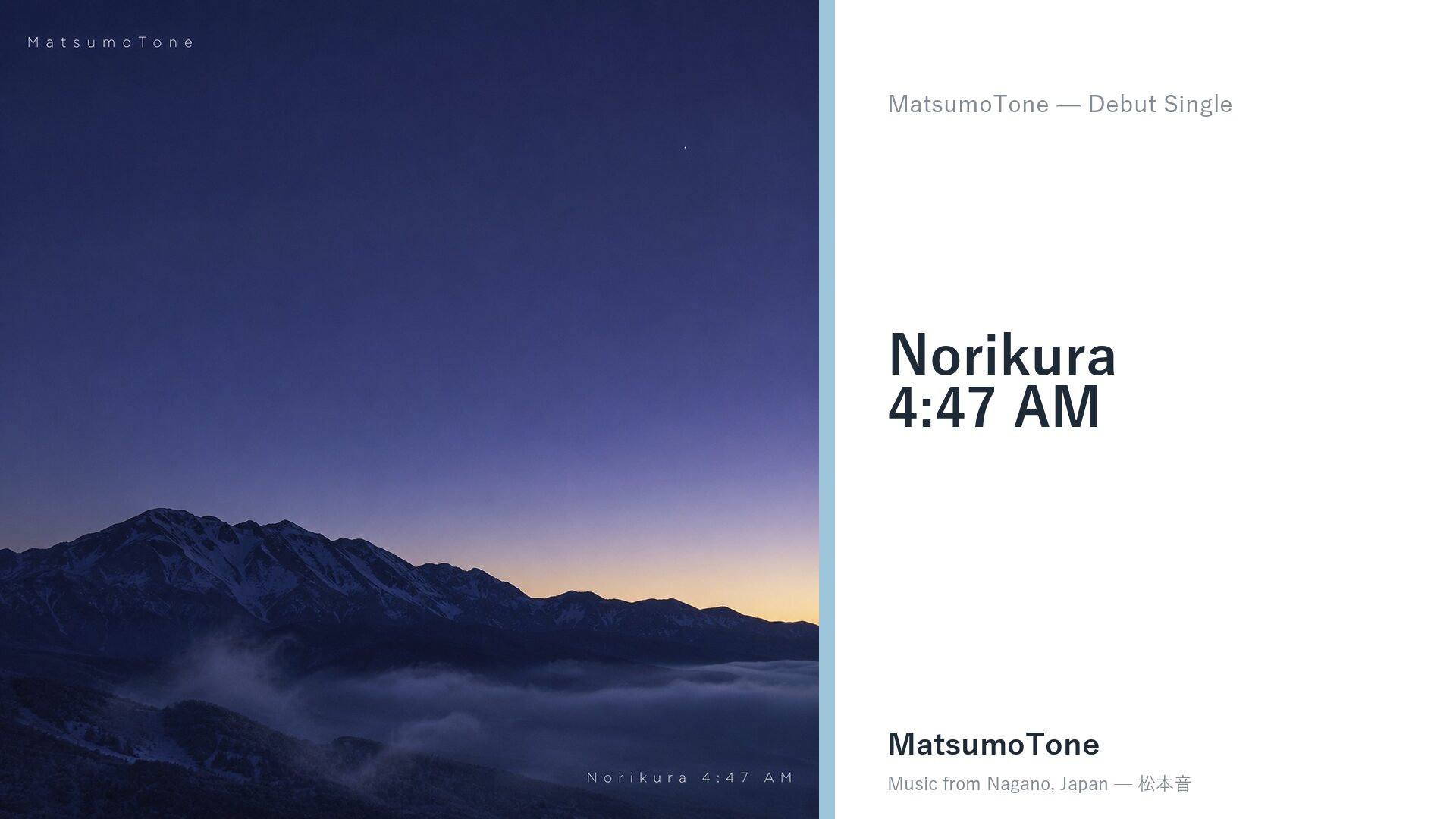
At 4:47 in the morning, on the ridge of Mount Norikura, the only sound is wind through dwarf pine.
This is the half hour after the eastern sky has begun to pale but before any colour reaches the snowline. The cable car has not started running. The hut wardens at Katanokoya are not yet awake. The trail to the summit is open, but no one is walking it. The thermometer reads four below freezing.
Anything that moves at this hour moves alone. Norikura 4:47 AM is the debut release of MatsumoTone. It was written for this hour and this place.
Mount Norikura — the gentle northern alp
Mount Norikura (Norikura, Mount Norikura) stands at 3,026 metres on the southern edge of the Northern Alps, the Northern Japanese Alps. It is one of the few three-thousand-metre peaks in Japan that ordinary visitors can reach without technical climbing.
A paved road — the Norikura Skyline — climbs to 2,702 metres at Tatamidaira, and a short walk on volcanic cinder takes you from there to the summit cone of Kengamine. For most of the year the mountain is a tourist destination: alpine meadows in late July, ptarmigan in early autumn, ski runs above the treeline in February.
But the mountain has another character at 4:47 AM. The Skyline is closed to private cars at that hour; the shuttle buses do not start until well after sunrise. If you are on the ridge then you have either spent the night in one of the small mountain huts at Katanokoya or Kengamine, or you have walked up from the lower huts in the dark with a headlamp.
Either way you are alone with the wind and the silver-blue light that precedes a Japanese alpine dawn. This track tries to be that air — that mixture of cold and quiet that you can hold in your lungs for a moment before the day begins.
Why 4:47, and not 5:00
The title is precise on purpose. There is no significance to 4:47 in the calendar, the timetable, or any local tradition. It is simply the minute on which a particular morning on this particular ridge happened to land, in early summer 2024.
The eastern horizon had a narrow band of warming pink. The ridge itself was still in deep blue shadow. There was a single contrail high above Mount Fuji to the south-east, catching the first sunlight maybe ten minutes before the rock at my feet would. The first faint colour was already in the sky; the stone was still cold.
Calling the piece Norikura 5:00 AM would have rounded the moment off into a postcard. The point of this project is to refuse that kind of rounding. Each release is allowed to be one named place, on one named morning, at one specific minute. Whether any listener will ever stand on that exact ridge at that exact minute is not the question. The question is whether the music remembers that the minute was real.
The wider field-recording philosophy behind this morning piece is laid out in the MatsumoTone concept post.

The sound
A single nylon-string classical guitar, played slowly, with long pauses between phrases. A few sustained bass notes underneath. Brushed cymbals far in the background. Six minutes, instrumental throughout. The harmony drifts gently between A minor and C major — the same neighbourhood Erik Satie liked to inhabit when he wanted music to behave like furniture.
Listen at low volume, alone, with the window open if possible. The track is not built to fill a room. It is built to leave space for whatever is already in the room.
If I am honest, the bass figure around 1:44 still bothers me a little — it sits a touch too uniform against the rest of the texture, more like a sequencer than a hand, and I wish I had revisited it before release. Small details like this are part of why this project feels like an ongoing rework rather than a finished thing. I have left it in. The piece is what it is, and pretending otherwise on a debut would be the wrong note to start on.
Why this is the debut
Of all the pieces sitting in the drafts folder, this one was chosen to go out first because it states the project’s three working rules in their simplest form.
One — a named place. Every release in this project ties to a specific Nagano location. Not a region, not a season in the abstract, but a place that can be pointed to on a map. Here it is the ridge between Katanokoya and Kengamine on Mount Norikura.
Two — a named moment. Each piece carries a specific time and weather inside its title or its sleeve note. Norikura 4:47 AM is the simplest possible version of that rule: a number, an hour, an alpine pre-dawn in early summer.
Three — quiet first. The music is composed for low-volume, single-listener listening — an early-morning kitchen, a window seat, a pair of headphones at the end of a long day. It is not built for a festival stage, a workout playlist, or a car stereo. If you turn it up loud it loses its argument.
Everything else released under MatsumoTone — the four-movement Snowmelt Suite, the pieces still to come — sits inside these three rules. The debut is the rules at their barest.
For an adjacent dawn at the same alpine plateau, see the drone-based companion album.
Why solo, and not a duo or a trio
A solo recording of an acoustic guitar at four in the morning makes an unusual demand on both the player and the instrument. There is no second player to mask any wavering in attention; there is no rhythm section to maintain the underlying pulse if the soloist drifts; there is no harmonic context other than what the player is supplying in real time. For the recording to function as a forty-minute piece rather than as a thirty-second sketch, every gesture has to carry its own weight. The choice of a solo format follows from the album’s pre-dawn setting: at four in the morning on a high alpine plateau there are no other musicians, no other voices, no other instruments — there is one body, one set of hands, one instrument, and a very specific kind of silence around them. A duo recording would have falsified that condition. A solo recording leaves the condition intact.
The guitar is a small-bodied steel-string of the kind that became standard for fingerstyle players in the late twentieth century — a Martin 000 or its equivalent. Small-bodied guitars project less low-end than dreadnoughts; they are quieter overall; they reward the kind of close-position playing that the album’s pre-dawn material asks for. A loud guitar in this setting would be wrong. The recording captures the instrument from a single condenser microphone at chest height, with no compression and minimal post-production reverb. What the listener hears is, as closely as possible, what the player heard while sitting in the room.
The album as a debut, and what that meant
As the label’s debut release, this album carried an outsized responsibility. It had to establish, in roughly forty minutes, what the label’s basic aesthetic premise was, what kind of geographic specificity it would insist on, what relationship to time of day it would observe, and what kind of listening contract it was offering its audience. Each of those decisions, once made publicly in the debut, would constrain everything the label could subsequently release. The choice of a solo guitar recording at a specific pre-dawn hour on a specific alpine plateau was therefore the label’s mission statement compressed into the smallest possible musical form.
The decisions made here propagated forward. Subsequent releases respected the time-of-day specificity (the city pop album is anchored to specific late-night hours; the bathhouse album is set at a specific late-evening hour; the bon-odori track is set on a specific August weekend). Subsequent releases respected the place specificity (every album is anchored to a named location in central Honshu, none of them invented). Subsequent releases respected the listener contract (the music is offered as company, not as content; the listener is invited to drift). All of this can be traced back to this single solo guitar recording at four forty-seven in the morning.
The morning hour and what makes 4:47 specific
Four forty-seven in the morning is the specific time that the recording was made on the specific morning the album describes — late September on the Norikura plateau, when civil twilight is at roughly 05:25 and full sunrise is around 05:55. That puts 04:47 at the very back of nautical twilight, when the eastern sky has begun to lift from full black toward a low blue but well before any direct sunlight reaches the plateau. The forty minutes between 04:47 and the first audible bird call are the album’s actual subject. The choice not to round the title to a more memorable number — 04:30, 05:00, 04:45 — was deliberate. The hour was the hour. Renaming it would have falsified it.
That kind of specificity has consequences for the listening experience. A listener at 4:47 in the morning, anywhere in central Japan in late September, will be experiencing approximately the same external light condition that the album was recorded inside. The album becomes, in those circumstances, less a recording of an environment and more a kind of mirror — the listener’s environment matches the album’s environment, and the album’s quiet contribution is to make the listener notice this match. Played at any other hour, the album still functions, but it functions as an imagined room rather than as a present one.
A practical note on the recording’s quiet detail
The album was recorded with a single microphone at chest height, in a small room with no acoustic treatment, with the player seated on a low chair and the guitar resting on their left knee. Several non-musical sounds were left in the final mix: the player’s breath at the start of each piece, the small creak of the chair on certain bass-string strokes, the tap of a fingernail against the guitar’s top when the right hand resets between phrases. None of these were intentional during the recording. All of them were intentional during the mix. They preserve the fact that a body was making this music, in a specific room, at a specific cold pre-dawn hour. Removing them would have produced a cleaner recording and a less truthful one.
How to listen
Norikura 4:47 AM is available on all major streaming platforms. Hear the full release on Spotify, Apple Music, Amazon Music, and everywhere else.
The best way to hear it is alone, in early morning, with the volume low. A few listeners have written to say they play it as their first sound of the day, before opening email or the news. That, more than chart position, is what the piece was made for.
Some streaming links on this site are affiliate links. See our Affiliate Disclosure for details. Project context: Why MatsumoTone / about / next release: Snowmelt Suite.
The recipe
This site is, at bottom, a set of recipes. Here is this one, whole. It is an instrumental — no lyric, no voice, only a nylon-string guitar and the cold. Paste the block below into Suno’s Styles field, set the three dials as noted, and you are standing where this piece was grown.
Settings. Instrumental, no lyrics · Weirdness 35% · Style Influence 60% · Title, Norikura 4:47 AM.
modal jazz, ambient post-bop, fingerstyle nylon guitar, ECM 1970s aesthetic, contemplative predawn, D Dorian, horizontal modal tonality, Dm pedal point, rubato, Dmaj7sus4

Solo fingerstyle nylon-string guitar, D Dorian, alpine predawn 4:47 AM on Mount Norikura, Matsumoto. Melody flows over sustained Dm pedal point, no functional cadence. Wide register, gravity-assisted touch, breath-paced phrasing. 72 BPM, rubato opening with ritardando first 8 bars, settling into unhurried pulse. Solo guitar dominant; double bass whole-note pedals from 0:45, brushed cymbals from 1:30, no drum kit. ECM 1970s — cathedral-soft reverb, close-mic intimacy, wide stereo, audible string articulation and finger noise. Modal shift D Dorian to D Lydian at 1:45, characteristic 6th and #4 emphasized. Resolution avoided throughout, ends suspended Dmaj7sus4 fading to silence — cold morning air in the lungs. Introspective, serene, slightly mysterious. Familiar yet undiscovered.
One honest caveat. A key, a tempo, a modal move — these are intentions, not guarantees. The music is generated, and a generator never follows the recipe to the letter, so what you hear will drift from what is written here. Read it as the concept, not a spec sheet. Half the pleasure is hearing where it wandered off on its own.