Asama Spectral Mass — Five Drone Movements in an Abandoned Bathhouse
MatsumoTone
MatsumoTone

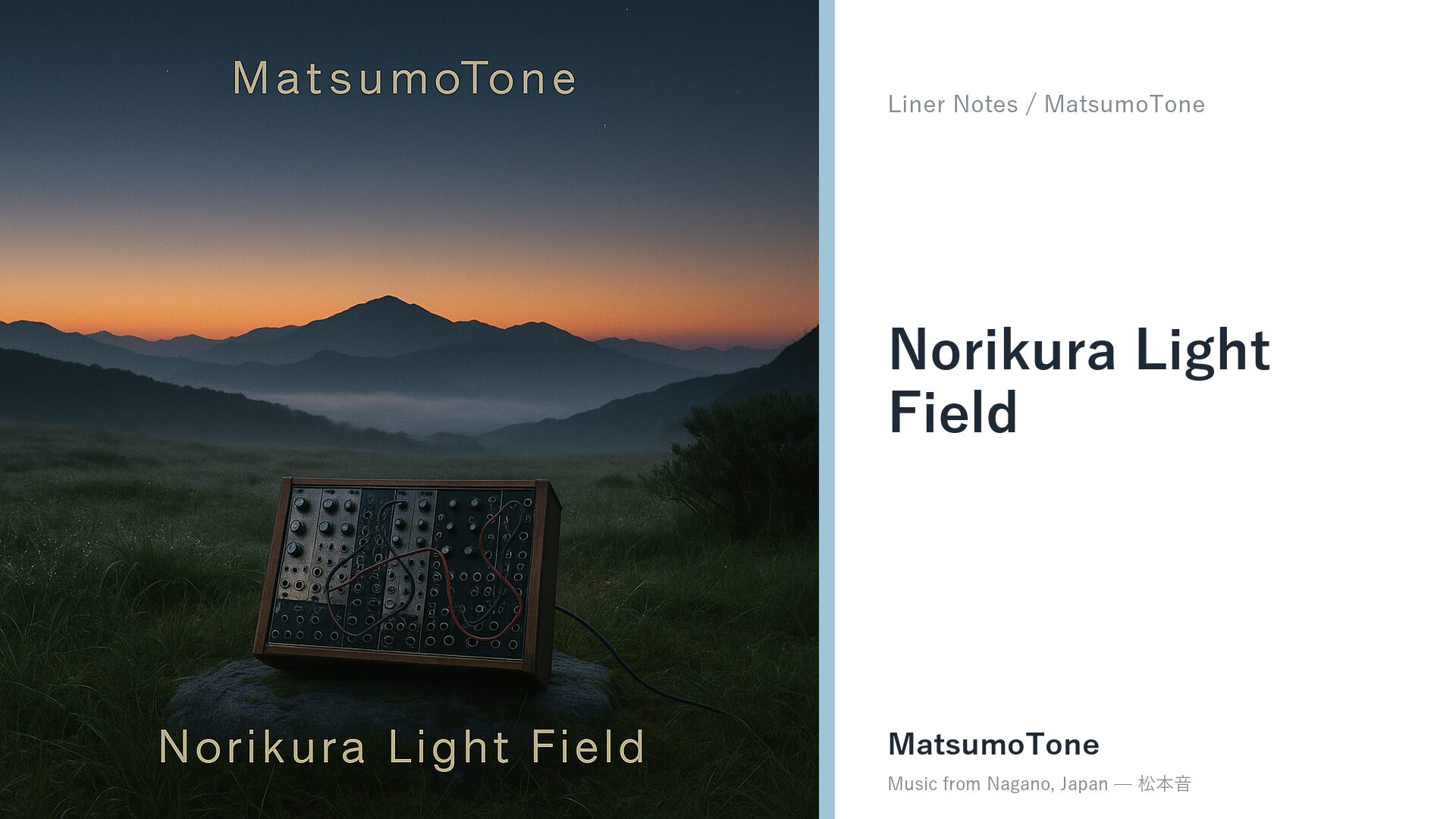
Mount Norikura has been the home address of this project from the beginning. The debut single was a single guitar on its summit ridge at 4:47 a.m. This album returns to the same mountain, half an hour earlier, with no guitar, no acoustic instrument at all — just an analog modular synthesizer and a contact microphone on cedar bark.
Norikura Light Field is the fifth MatsumoTone mini-album. Five slowly evolving drones, about twenty-one minutes in total, recording the half hour before the alpine sunrise on the Norikura plateau.
The Norikura plateau between Tatamidaira and Kuraigahara sits at around 2,700 metres above sea level. In summer it is alpine meadow. In late June at 4:30 a.m., the air is still around minus two degrees, the wind through the dwarf pine is more constant than musical, and the cedar bark a few hundred metres below the treeline holds a kind of silent radiation that a contact microphone can detect as low-frequency drone.
The album records that radiation. A field recording of cedar bark vibration feeds into an analog modular synthesizer; the synthesizer answers back; the cedar continues to vibrate; the synthesizer evolves. Where Castle Town Static recorded the city, this album records what the city is not.
The whole album sits on a single fundamental — the note A, taken from the natural overtone series. There is no melodic development in the conventional sense. There is no rhythm. There is only the slow expansion and contraction of harmonic density around the fundamental.
1. Hill Mic Part 1 — 4:30 a.m. The pure A drone begins. Contact microphone on cedar bark; modular synthesizer enters in the second minute. The slowest piece on the album, the most observational.
2. Wind Modular — 5:00 a.m. The wind is now driving the envelope of the modular patch. Harmonic overtones start to emerge on top of the fundamental. The plateau is starting to breathe.
3. Granular Cedar — 5:30 a.m. A separate cedar-bark recording from a lower stand of trees is fed into a granular processor. The output is a cloud of small wooden grains around the same A fundamental, the densest texture on the album.
4. Hill Mic Part 2 — 5:50 a.m. The hill microphone returns, slightly faster, slightly less pure. Same source material as Part 1, treated differently. The album doubles back to its starting place before the final piece.
5. Sunrise Phase — 6:00 a.m. Phase-modulated lead enters above the drone. The full overtone series of A — A, E, A, C-sharp, E, G — emerges as a sustained chord. The sun comes up. The album resolves harmonically and stops.
These slow drones extend the MatsumoTone idea of music as field recording — see the concept piece.

The Western lineage of drone music — La Monte Young, Tony Conrad, Phill Niblock, the later work of Éliane Radigue — established a tradition of static or near-static music that treats duration as its primary material. Sounds that change so slowly the listener’s attention has to adjust its own time scale to register the change. That tradition is the explicit reference behind this album, but the album is not located inside that tradition. It is located inside a Japanese tradition that has its own, parallel history of slow sound: the long held notes of gagaku reed instruments, the unchanging tone of a temple bell as it decays over thirty seconds, the static texture of a ryuteki sustained breath. Japanese music has been comfortable with stasis for centuries.
The album places its drones at the intersection of those two histories. The harmonic language is Western — the long held A natural that anchors all five pieces is tuned to A 440, the standard Western concert pitch, rather than to any of the older pitch standards. The treatment of duration is closer to the Japanese tradition — the slowness is presented as natural rather than as a radical compositional choice, and there is no agenda of confronting the listener’s expectations. Confrontation is not the point. The plateau at four in the morning is not trying to confront anyone.
The Norikura Kogen plateau sits at roughly 1,500 metres on the eastern flank of Mount Norikura, accessible from Matsumoto by road in about ninety minutes. Above the plateau the access road continues to roughly 2,700 metres, near the alpine treeline. The album imagines the listener stationed somewhere in between — on the lower plateau, where the trees are still mature, but high enough that the air has the sharp clarity of altitude and the night sky is one of the densest visible in central Japan.
Four in the morning is the most acoustically quiet hour at that altitude. The wind that runs through the larch forests during the day has dropped. The few cars on the access road have stopped. The animal sounds of the previous evening have ended. The animal sounds of the coming day have not started. There is a window of roughly forty minutes — between approximately 04:00 and 04:40 in late September — during which the only audible sound on the plateau is one’s own breath and the low rumble of the body’s circulation. The album is built to sit inside that forty-minute window without disrupting it.
The grain cloud on the middle piece sits a touch louder than the surrounding pieces; in retrospect I should have pulled it back two dB. But that loudness also lets the piece feel like the structural midpoint it is — the densest minute of the album, the moment before the symmetry doubles back. Mixed feelings. Left as is.
For a solo-guitar morning from the same alpine plateau, see Norikura 4:47 AM.
All five pieces are in A. None of the five pieces is the same piece. The differences are in the upper partials, the rate of beating between detuned components, and the slow microtonal drift in the inner voices. A listener who hears the album once will hear five long held tones that all sound the same. A listener who hears the album five times, on five different mornings, will begin to hear five distinct atmospheric weather systems — the way a person who pays close attention to clouds begins to see distinct cloud species where the casual observer only sees clouds.
This kind of differentiation is the album’s primary content. It does not unfold; it is unfolded by repeated listening. The album rewards a relationship over a single attentive session. It is closer to a piece of landscape than to a piece of programmed entertainment. A view from the same window every morning for a season is more informative than ten different views in one day.
Pre-dawn altitude does specific things to the body. The blood vessels at the surface of the skin are constricted to retain heat; the pulse is slower than at sea level; the breath is deeper but less frequent. Listening to drone music in that condition is different from listening to drone music in a warm urban apartment. The body’s own slowed rhythms align with the music’s slow temporal scale, and the music stops being something happening externally and starts being something the body and the music are doing together. The album was scored, in this sense, to the listener’s pre-dawn physiology, and not just to the plateau’s air.
Headphones in a quiet room, low light, no schedule pressure. Or large room speakers at low volume in the early morning, with the curtains open enough that the room is filling slowly with daylight as the album plays. The album’s runtime can be played start to finish, or any of the five pieces can be played in isolation as a longer single-piece experience. There is no internal narrative that demands the full sequence. The order is suggestive, not obligatory.
The album’s runtime, just over forty minutes from start to finish, was set deliberately to match the duration of the actual pre-dawn quiet window described above. A listener starting the album at 04:00 in late September on the Norikura plateau will reach the final piece’s last sustained tone at roughly 04:40 — which is, in practice, the moment when the first audible bird call of the morning interrupts the silence and the listening session naturally ends. The album was scored to that ending. The last sustained tone, by design, is timed to be displaced from the listener’s attention by the actual sound of the dawn beginning, in any environment where dawn is happening. In an indoor environment without dawn, the album simply concludes; the structure functions regardless. But the album was scored for the outdoor case, on the plateau, in autumn, at four in the morning.
This kind of scoring — music whose duration is set by the duration of a real-world event rather than by the conventions of the genre — has a long history outside Western art-music. Ritual musics of many traditions are timed to the duration of the ceremony they accompany. The album joins that lineage by accident as much as by design; the timing simply followed from the location.
The granular cloud that sits at the album’s harmonic centre is built from tens of thousands of short overlapping samples of a single bowed double-bass note tuned to A. The samples are not played; they are scattered. The result is a sustained tone whose surface is in constant micro-motion, like the surface of a high alpine lake from a distance — apparently still, on closer inspection composed entirely of small overlapping wave patterns. The five pieces use the cloud differently: brighter overtones in piece one, lower partials emphasised in piece three, with the other three sitting between those poles. The brightness is a function of which slice of the cloud is being foregrounded. The bass remains the same throughout. Only the listening window changes.
If the album is to be played outdoors at the actual Norikura plateau, a battery-powered small speaker is recommended rather than headphones. Headphones at high altitude in cold air can cause physical discomfort after about thirty minutes, and they isolate the listener from the actual environmental sound the album is meant to coexist with. A small speaker placed on a flat rock, played at a volume just above the ambient noise floor, will integrate the album with the plateau in a way that headphones cannot.
Listeners who play the album once and find it unmoving are not necessarily mistaken. The album is built for accumulation, not for immediate impact, and a single play may correctly produce no strong reaction. The recommended next step is to return to it on a different morning, at a different time of year, in a different listening posture. The album’s contents do not change between plays. The listener’s relation to them does. That relation is the album’s actual subject.
Norikura Light Field is available on all major streaming platforms. Hear the full release on Spotify, Apple Music, Amazon Music, and everywhere else. Best heard at low volume, early in the morning, with the window slightly open.
Light has no rhythm, which makes it a strange thing to hand a generator. Here is the paragraph I handed it anyway. It is a seed and not a score — the drones came back longer and stranger than written, and I left them that way. The field they spread across was drawn in these lines. Paste it into Suno’s Styles field, set the dials, and watch the same sky.
Settings. Instrumental, no lyrics · Weirdness 40% · Style Influence 70% · Title, Hill Mic Part 1.
modular ambient, field-recording electronica, analog modular synthesizer with eurorack patches, contact microphone on cedar bark, long reverb, A drone, free tempo, pre-dawn high plateau

Instrumental piece, no vocals, no traditional drums. A drone (pure single-note A) is the harmonic foundation. Setting: 04:30 AM on Norikura plateau at 2700m altitude, contact mic on cedar bark. Form: Section A 0:00-1:00 drone build with field recording, Section B 1:00-2:00 modular synth motif emergence, Section C 2:00-3:00 granular response with cedar bark grains, Coda 3:00-3:30 slow fade. Harmony: A drone root with overtone series intervals (A-E-A-C#-E-G-A) introduced gradually. No traditional melody — slow textural evolution. Wide warm stereo, very long reverb tail, gentle tape saturation. Volume soft to medium. Target duration 3 min 30 sec to 4 min. MINIMUM 3 minutes 30 seconds — must NOT end before 3:30. Do NOT fade out early. Develop the full musical arc as written.
This is the opening piece. The remaining drones were grown from seeds like this one.
Key and tempo describe an intention. The field did what it liked. It held notes I never wrote, and I left every one of them in.
The same road climbs again in August, with numbers pinned to jerseys. I wrote that ascent as six stages instead of five drones: Matsumoto Pedalisme.
Some streaming links on this site are affiliate links. See our Affiliate Disclosure for details.