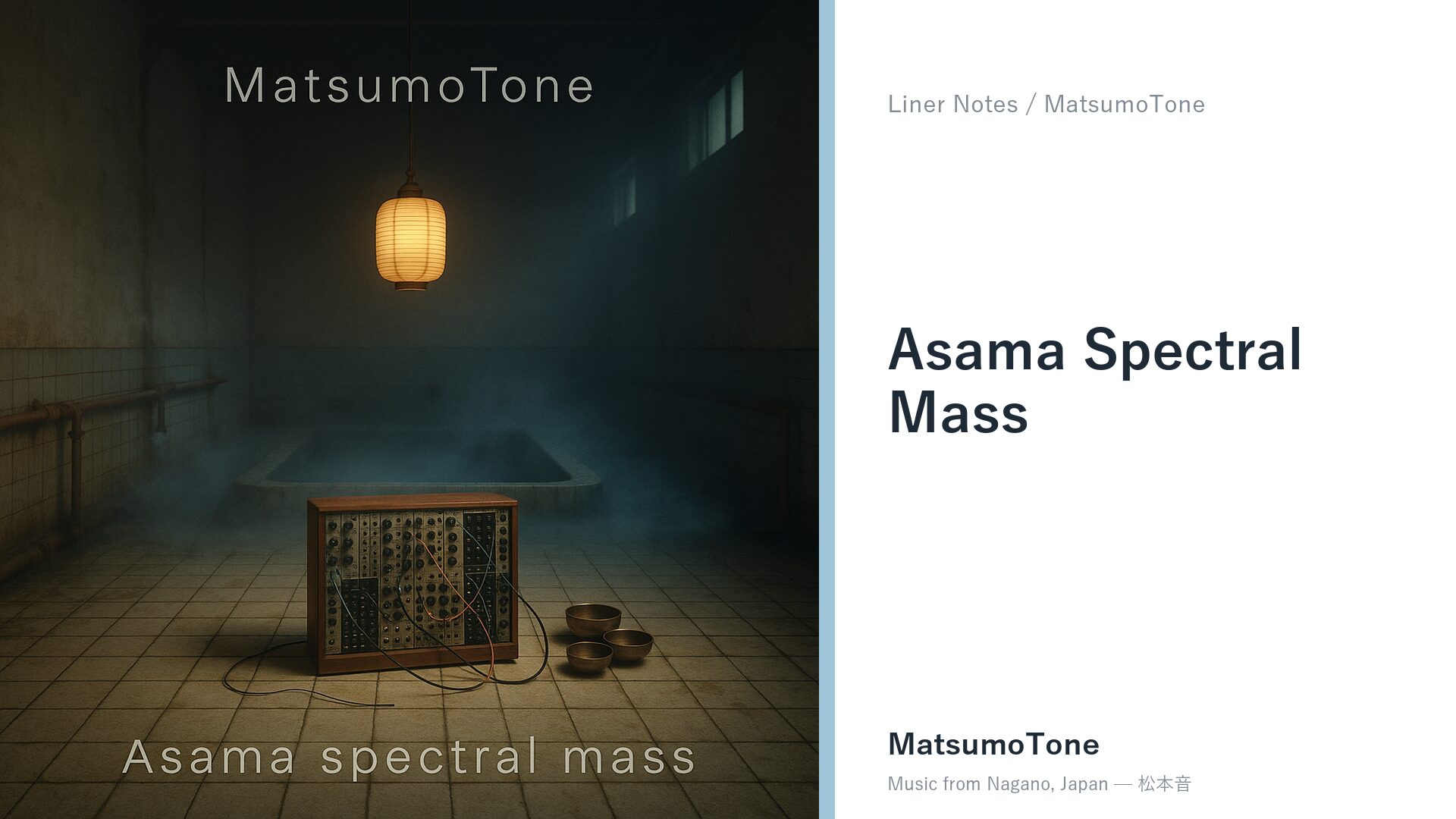
Asama Spectral Mass — Five Drone Movements in an Abandoned Bathhouse
MatsumoTone
MatsumoTone

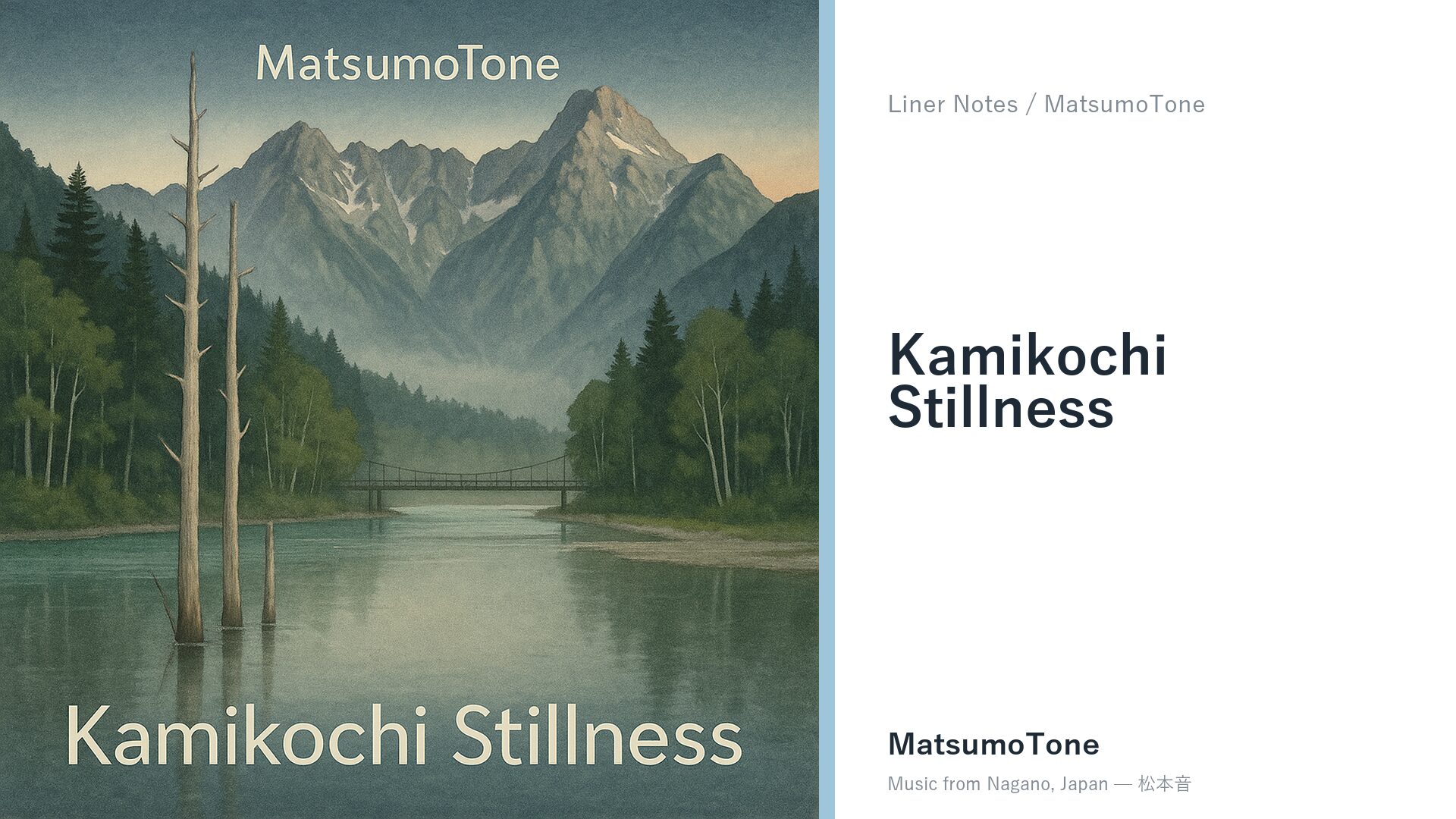
Kamikochi, the alpine valley of the Azusa River inside the Northern Alps, is one of the most visited mountain destinations in Japan. During the day in summer, the boardwalk by the Kappa Bridge is shoulder-to-shoulder with hikers and tourists. The buses run every fifteen minutes. The Taisho Pond reflection of Mount Yake is photographed thousands of times in a single morning.
This album is not about that Kamikochi. It is about the half-empty hours at either end of the day, after the last bus has left and before the first bus has arrived, when the valley belongs to its water and its bears.
Kamikochi Stillness is the tenth MatsumoTone mini-album. Four instrumental pieces, about eighteen to twenty-two minutes in total, alternating between piano-led ambient and small jazz combo, recording one full day of the empty side of Kamikochi.
European chamber jazz of the 1970s — the contemplative northern lineage, more concerned with space and breath than with bebop fluency — has always had a structural sympathy with alpine landscapes. There is a reason the visual identity of certain Northern European jazz labels of that era leaned so heavily on photographs of mountains and water.
The album takes that visual logic literally. Piano, double bass, brushed drums, a tenor saxophone speaking softly, a wooden flute on one piece — placed inside actual field recordings of the Azusa River. The jazz combo is the small human presence in an otherwise empty valley.
1. Taisho Pond, 5 AM — Before sunrise at Taisho Pond, the mist rising off the still water, Mount Yake silhouetted in the dark. Piano and field recording only. The longest, slowest piece on the album, in E-flat major. The opening movement is intentionally without metric pulse.
2. Kappa Bridge Crossing — 8 a.m. The boardwalks have woken up. A small jazz combo enters — tenor saxophone, piano, bass, brushed drums — in B-flat major with a slow ballad swing. AABA form, an extended outro that fades into the sound of the river.
3. Azusa Drift — 1 p.m. The midday flow of the Azusa River itself. A wooden flute joins the combo. The piece is in G dorian, the most chromatic mode on the album, structured as a slow waltz that drifts in and out of metric pulse. Field recording of the water is given equal weight to the instruments.
4. Yake Eve — 5:30 p.m. The last hour of light, looking up at Mount Yake. The buses have stopped. The combo dissolves back into piano and field recording. A-flat major, the warmest key, slow fade to silence.
Treating an alpine valley as compositional source extends the MatsumoTone field-recording stance — see the concept piece.

Most jazz is urban music — written for clubs, recorded with reverbs that simulate small rooms, structured around the kinds of timing pressures that exist when many people are arriving and leaving on a schedule. Recording a jazz combo as if it were sitting in Kamikochi in early autumn, with no audience and no schedule, required undoing several of those default settings. The reverb is long but never artificial. The tempo is unhurried but never indulgent. The soloing is restrained — there are no displays of technique because there is no listener in the imagined room who is waiting to be impressed. The musicians are playing for the trees.
Whether jazz combos can do this convincingly was the album’s open question. The genre’s instincts pull strongly toward conversational density. Asking a quartet to leave space without falling into ambient cliché requires every player to actively resist their training. The result is a set of pieces that sit closer to chamber music than to club jazz, though the harmonic language is unambiguously post-bop.
Kamikochi is the high alpine valley above Matsumoto, accessible only from mid-April through mid-November because the access road closes for winter. In the popular imagination it is a tourist destination — buses, hiking groups, the famous Kappa Bridge with its view of the Hotaka range. The album avoids that Kamikochi entirely. Its Kamikochi is the empty side of the valley, the early-morning hour before the buses, or the late afternoon after the buses leave; the side trails that run upstream along the Azusa River toward Myojin, where the visitor count drops to single digits per hour even in peak season.
That choice of location dictates the album’s sound. A combo in a crowded place plays differently than a combo in a quiet place. The pieces here are recorded as if the valley itself were the acoustic environment — long natural decays, no audience response, the occasional inserted field sound (water, wind through reeds, a distant crow) at a volume that suggests the room is large and unbounded.
The tenor on Kappa Bridge Crossing sits slightly forward in the mix — closer than the strict ECM aesthetic would suggest. It is, in the end, a person playing a horn on a wooden bridge in the morning, not a person playing a horn in a Norwegian recording studio. The proximity of the instrument is part of the location.
A more intense counterpart from another deserted Shinshu site: Asama Spectral Mass.
In Western art-music vocabulary, stillness is often treated as a negative — the absence of motion, the rest between gestures, the silence that frames the sound. Japanese aesthetics have a longer tradition of treating stillness as a positive content in its own right. The poet does not look at the cherry blossom; the poet looks at the act of looking at the cherry blossom. The garden is not the rocks; the garden is the space between the rocks. Kamikochi Stillness takes that orientation as its compositional starting point. The album is not a quartet playing slowly. The album is a quartet inhabiting stillness, with notes occasionally permitted to surface.
The tenor saxophone carries most of the lyrical work because the tenor’s range and breath length most closely match the rate at which a slow valley breathes. The saxophonist’s exhales are audible in the recording. That audibility is deliberate. A horn player who is hiding their breath is performing for an audience; a horn player whose breath is left in is alone in a room. The album asks the listener to share that room, but only on the condition that the room remains quiet.
The four pieces sequence as a single day in the valley, beginning before sunrise and ending in early dusk. The first piece is genuinely dark — the saxophone enters before the bass, before the piano, before the cymbals, while the field recording underneath suggests a temperature of around four degrees Celsius and a breath that is visible. The second piece occupies mid-morning, when the sun has cleared the eastern ridge and the river has briefly woken up. The third is around three in the afternoon, the slowest hour of the day in a high mountain valley, when the wind has dropped and even insects have stilled. The fourth is the long descent into dusk, the saxophone fading into the cymbal wash as the temperature drops again.
None of the four is a portrait of a place. Each is a portrait of being in a place, at a specific hour, alone enough that the breath becomes part of the soundscape. That is the album’s argument: jazz, treated this way, is one of the genres best suited to rendering the experience of solitude in a large quiet space.
Indoor, low-volume, low-stakes listening. Morning coffee with the curtains open. Late-night reading. Any context where the listener can permit themselves to drift in and out of attention without feeling that they are mismanaging the music. The album does not punish wandering; it assumes it. Headphones are fine but not necessary. The pieces are mixed wide enough that decent room speakers will render the depth.
Each of the four pieces sits above a low-level continuous field recording made in the Kamikochi valley over several pre-dawn and early-morning sessions. The field recording is mixed at roughly 30 dB below the music — close to inaudible during attentive listening, but contributing to the album’s overall sense of room. Water at the Myojin reach of the Azusa River. Wind in the alpine willow above the Kappa Bridge north bank. The very specific creak of cold-stiffened wooden planks on one of the side bridges at first light. None of these sources is named in the liner notes; they are infrastructure, not features.
The choice to bury the field recording rather than foreground it follows from the album’s general orientation toward stillness. A field recording placed on top of a piece of music is a documentary gesture — it says, this is the sound of a place. A field recording placed underneath a piece of music is an environmental gesture — it says, this is the room the music is in. The first treats the place as content. The second treats the place as condition. Kamikochi Stillness is unambiguously the second.
Within the label’s catalog, three albums sit on the same alpine high-ground tier: this one in Kamikochi, the morning solo guitar piece from Norikura, and the slow-drone piece from the Norikura plateau at pre-dawn altitude. The three differ in instrumentation, tempo, and mood, but share a common premise — the alpine zone above 1,300 metres in central Honshu is a distinct acoustic and emotional region, separable from the city below and worth treating as music’s primary subject rather than as a backdrop. The three albums together describe that region at three different times of day, in three different ensemble configurations. They are intended to be heard as a loose cycle, though each is self-contained.
The album was sequenced for unbroken listening from start to finish. The four pieces were composed to lead into each other; the silence between tracks is deliberately short. A listener who plays the album on shuffle, or who skips between tracks, will lose the inter-piece continuity that the album is partially built around. The sequence is the work. If listening time permits only one piece, the third — the mid-afternoon piece — is the most self-contained and the most representative of the album’s overall tone.
The album is titled Stillness rather than Silence for a specific reason. Silence is the absence of sound. Stillness is the active condition of a sound-rich environment that has paused. The valley at four in the morning is not silent — water moves under thin ice, branches occasionally settle, the listener’s own circulation is audible. It is, however, profoundly still. The album’s central acoustic ambition is to render that distinction accurately. A silent album would have been a different and probably duller record.
Kamikochi Stillness is available on all major streaming platforms. Hear the full release on Spotify, Apple Music, Amazon Music, and everywhere else. Best heard in one sitting, in order, as a single eighteen-minute mountain day.
Stillness has to be described in motion, or a generator gives you silence. So this paragraph is full of small movements that never arrive anywhere. Read it as a seed and not a plan: what came back drifted, and I kept the drifting. The valley in the sound was mapped in these lines. Paste it into Suno’s Styles field, set the dials, and stand where I stood.
Settings. Instrumental, no lyrics · Weirdness 25% · Style Influence 75% · Title, | Taisho Pond, 5 AM |.
Solo grand piano with field recording, free unmetered ambient. E-flat major, sparse single-note voicings, no chord progression, harmonic stasis. Piano touch feather-light pianissimo to mezzo-piano, each note with full sustain pedal, natural decay 8-12 seconds. Notes fall in irregular 15-30 second intervals, no rhythmic pulse, no metric time. Spectral freeze on selected notes producing slow harmonic morphing. Field recording: distant water dripping in alpine pond, gentle wood creaking, faraway thunder, low river murmur. Wet stillness of pre-dawn alpine air. Close-mic on Steinway-like grand piano, subtle convolution reverb of valley basin. Through-composed ambient form, no repeats. Piece slowly accumulates spectral weight then dissipates. Just-intonation tendency on selected piano notes. Aesthetic of 1970s European chamber music and British listening-environment ambient. Subtle analog tape-hiss. Wide stereo field rec, narrow centered piano. The piece breathes like cold dawn air.This is the opening piece. Everything else here was made the same way, pointed at the same hours.
Take the tempo as a mood. Nothing in this record keeps time that strictly. Where it wandered is where the valley actually opened up.
Some streaming links on this site are affiliate links. See our Affiliate Disclosure for details.