Matsumoto Pedalisme — Six Stages of Two Nagano Hill Climbs in Analog Electronics
MatsumoTone
MatsumoTone

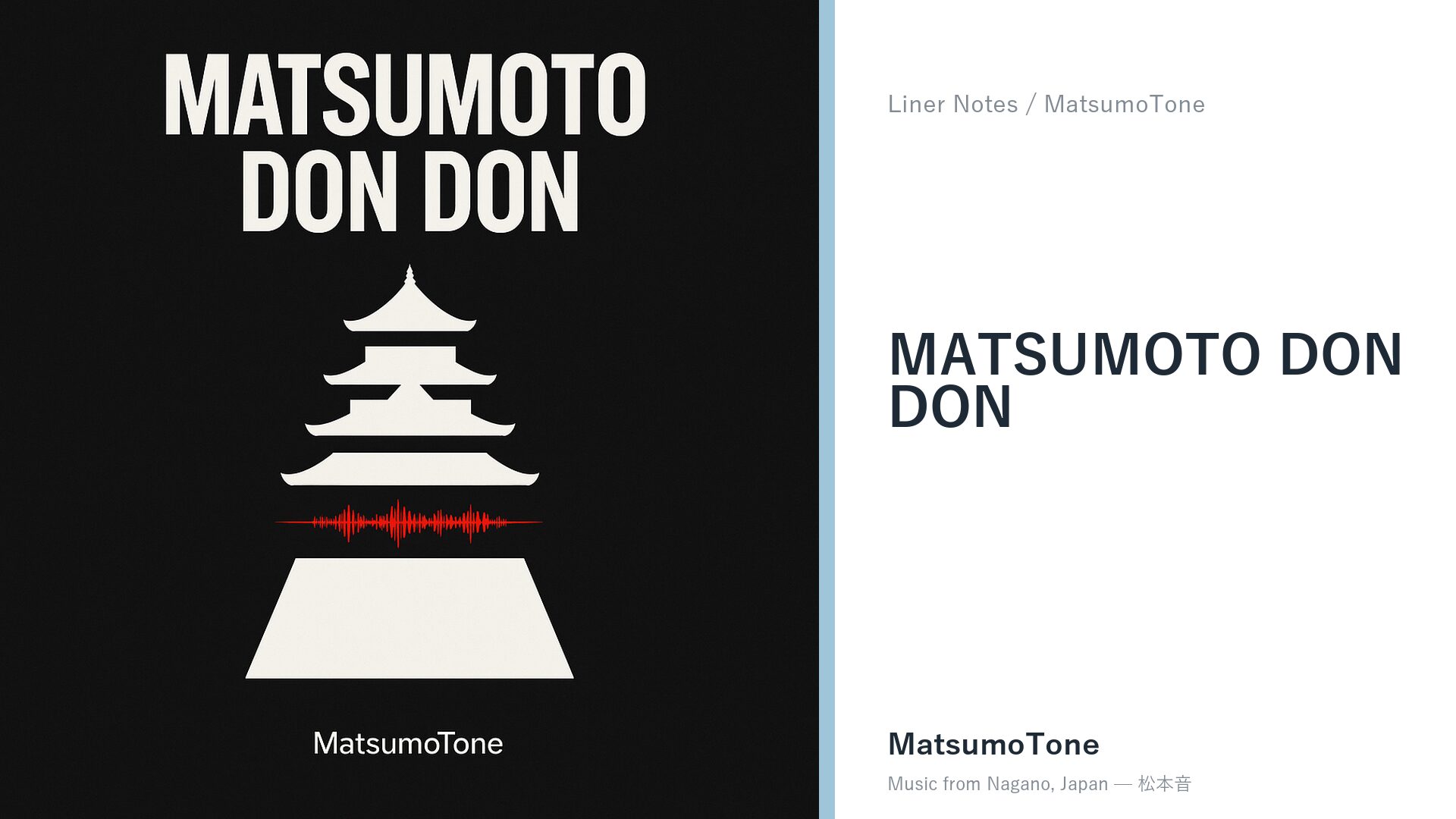
Every August, the streets around Matsumoto Castle fill up with thousands of people in summer yukata, all dancing in slow concentric circles to a single song that everyone in the city has known since they were children. The song is called Matsumoto Bonbon. It is older than most of the dancers, and most of them will dance to it again every August for the rest of their lives.
MATSUMOTO DON DON is a standalone single. It takes the harmonic skeleton of that local folk-dance song and reimagines it as a Dutch big-room festival anthem — Tomorrowland mainstage, four-on-the-floor kick, super-saw lead, the works — with shinobue and taiko still audible inside the build-up.
Matsumoto Bonbon was written in 1975 to give the city of Matsumoto a single dance song that any resident, of any age, could perform together in the street. The composers took the local taiko pulse, a manageable minor-key chord loop, and a chant short enough that a five-year-old and a seventy-year-old would land on the same beat. Fifty years later it has become exactly the thing it was commissioned to be — a song that almost no one in Matsumoto can remember a time before. Every August the central streets of the city close to cars and reopen as a slow-moving river of yukata.
That kind of song is rare. Most popular music is private — you put on headphones, you go inside your own head. Matsumoto Bonbon is the opposite: it only exists when several thousand people are doing the same thing to it at the same time. That is also, structurally, what big-room house was invented to do. The two genres do not sound alike, but they were designed for the same human need.
Bon-odori — the summer Buddhist dance for the returning ancestors — is the original Japanese festival music. Big-room house is the contemporary festival music. Both genres are built around a small repeating pattern that thousands of people move to simultaneously. Both are designed so that you do not need to know the dance in advance; you just join the circle and your feet figure out the rest.
The shared structural DNA was the door. The chord progression of Matsumoto Bonbon — E♭ to G minor to A♭ to B♭ — happens to be a perfectly serviceable festival house progression in the key of C minor. With the same chords looped underneath, the original folk melody can survive a slap-bass mainstage drop almost untouched.
The harmonic loop underneath Matsumoto Bonbon — E♭ to G minor to A♭ to B♭ — is, in functional terms, ♭III–v–♭VI–♭VII in the key of C minor. That same shape, with different production values on top, is one of the most reliable chord loops on the festival mainstage. It is the loop you hear under the white-noise sweep just before a Tomorrowland-scale drop. It is also the loop you hear under thousands of feet stepping in a circle around a watchtower in Shinshu. Same skeleton, two ecosystems.
This is not a coincidence — it is what happens when two musical cultures both gravitate toward the simplest cyclic loop a large crowd can dance to without rehearsal. Minor-mode, four bars, descending sense of arrival on bar four, no surprises. Once you notice it, you start to hear that the genre boundaries are mostly cosmetic. MATSUMOTO DON DON just removes the cosmetics from both sides and lets the shared skeleton stand naked for three minutes.
The lyric stays inside the city. Nawate-dori for the lanterns. Daimyocho for the yukata crowd. the Metoba River for the fireflies. Asama Onsen for the after-party. Fukashi and Aoyama for the home walk. No Azumino, no the Northern Alps, no Kamikochi — those places have their own albums on this label. This song belongs to the streets you can walk to from the castle in less than thirty minutes.
Each of those names carries a specific sensory load for anyone who has spent a summer in the city. Nawate-dori smells of grilled gohei-mochi and yakitori smoke threading between two-storey wooden shopfronts. Daimyocho is wide enough for a parade and lined with the kind of low Showa-era department stores that still hang paper lanterns from their awnings in August. the Metoba River is the long, shallow river that the city’s old quarter folds around; in the evening the fireflies above its bank flicker at a rate not far off the kick drum of this track. Asama Onsen is the bath district up the eastern slope where you go after the dance to rinse the heat off. The song does not have to describe these places in detail because the names are already doing the work — they each unlock a smell, a temperature, a memory of feet on warm asphalt.
The MatsumoTone approach of letting local material drive form is detailed in the concept post.

Three things survived intact from the original:
Everything else was replaced. The original chant phrase was swapped for the syllable DON, the kick was rebuilt as a monster four-on-the-floor, the chord stab became a super-saw, the bass became an 808 sub, and the entire structure was relayered into the standard festival anthem shape: intro, vocal verse, pre-chorus, white-noise build, drop, second verse, bridge, final-build, key change, last drop, outro. Nothing in the new layer carries any actual melodic material from the source. The source is felt only through the chord loop, the call words, and the wind-and-skin instruments in the breaks.
The track is built as a standard festival anthem: intro with shinobue and taiko, vocal verse, pre-chorus build, white noise sweep, drop. The drop is where the song earns its title — a taiko monster kick on every beat under a super-saw chord stab, with the call MATSUMOTO DON DON as the festival chant. The word ‘don’ is the sound the taiko makes. The word is also a percussion instrument. The line is both the chant and the rhythm under the chant.
Don in Japanese is the sound a taiko makes when struck flat at the centre of the skin. It is also a generic onomatopoeia for any percussive impact — a door closing, a heart beating, a firework. In this track the syllable is asked to do three jobs at once: it is the festival chant, it is the literal sound of the kick drum that lands on every beat under the chant, and it is the verb form people will use to describe how they felt during the drop. Phonetic, percussive, semantic. Three layers from one consonant cluster.
The festival hook MATSUMOTO DON DON was chosen because it is impossible to mishear, impossible to mistranslate, and impossible to lip-sync wrong. A child can chant it. So can a tourist who does not speak Japanese. So can a speaker stack in a club at 128 BPM.
The final chorus modulates up from C minor to D minor — a standard pop modulation, almost a cliché in J-pop and in festival anthems alike. It is shameless. It is also what Matsumoto Bonbon itself does in its final repetition every August. Some clichés are clichés because they reliably make a crowd shout louder. The album version keeps the modulation in.
A more contemplative companion using regional ritual sources: Shinshu Raga Pilgrimage.
Sonically the track sits in the Dutch big-room tradition that ran from roughly 2012 onward — the era of stacked super-saws, monster kicks, and chord stabs that climb a whole step before the final chorus. The whole-step climb itself is the most reused pop trick of the last hundred years, deployed everywhere from Whitney Houston’s last choruses to Avicii’s “Wake Me Up” to the encore of every karaoke night since karaoke existed. Two opposite traditions of vernacular music — American gospel-pop and Northern European EDM — converged on the same modulation because it works the same way on the same human nervous system.
Matsumoto Bonbon itself does the move every August, in its very last repetition, when the temple bells and thetaiko step up a whole tone and the dancers’ arms reach a fraction higher above their heads. The bon-odori tradition arrived at the same trick independently, centuries earlier. MATSUMOTO DON DON just leaves it in.
A bon-odori is not really a performance — it is a slowly rotating crowd. Dancers move clockwise around a tall wooden tower called a yagura, on top of which a small group of taiko players and singers keep the pulse. Because the pulse comes from physically above the crowd, you feel it as much through the soles of your geta as through your ears. The pavement around Matsumoto Castle has been transmitting that bass for half a century now.
Festival house, despite its volume and its sub-bass, asks the body for the same thing — a steady weight transfer from one foot to the other on every beat, low arms loose, breathing aligned with the kick. The mainstage drop is just a louder yagura. The chord stab is just a louder taiko. The white-noise sweep is the moment the singer would have lifted their fan above their head to cue the next refrain. MATSUMOTO DON DON takes those equivalences as given and asks the body whether it can tell the difference. In the right environment, it cannot.
That equivalence is also what makes the song a quiet protest against the idea that “festival music” and “traditional music” are separate categories. They are not. They are the same impulse arriving in two centuries.
The track was built for one specific environment: an outdoor speaker stack between sundown and midnight, in August, somewhere that the air still smells faintly of grilled corn and senko-hanabi. It will work in a car with the windows down, on a beach, or at the back of a rooftop bar — but it will work best at exactly the place it was written about, on the streets around Matsumoto Castle during the festival weekend.
It is loud, repetitive, and physically demanding. It is not background music. Treat it the way the original treats itself — as a song you stand up for.
If you cannot make it to Matsumoto in August, the closest substitute is a hot evening with the windows open, the volume up enough to bother no one but yourself, and a clear hour with no other obligations. The song is short. The point is not to listen to it carefully; the point is to stop sitting down for three minutes.
MATSUMOTO DON DON is available on all major streaming platforms. Hear the full release on Spotify, Apple Music, Amazon Music, and everywhere else. Recommended listening environment: loud speakers, with company, in August.
A festival is rhythm before it is melody, and that is what this paragraph mostly describes. Read it as a seed: the generator gave back something looser than what I wrote, and I let most of that looseness stand. What did not move was the pulse, and the pulse was set here. Paste it into Suno’s Styles field, set the dials, and the street starts filling.
Settings. With lyrics · Weirdness 30% · Style Influence 90% · Title, MATSUMOTO DON DON.
================================================================

catchy summer anthem, viral playlist hit, danceable, clean melodic hook, female lead vocal with male call-response, japanese summer festival atmosphere, radio-ready anthemic chorus, snare on 2 and 4, claps on backbeat, four-on-the-floor groove, deep sub-bass, sparkling synth pads, bright lead synth, vocal chops, taiko drum accents in builds and breaks, shinobue flute hook in intro and bridge, shamisen stab in bridge, kane bell crash on chorus entry, 128 BPM, infectious chant-style hook, sing-along chorus. DON DON MATSUMOTO DON DON DON is the dominant syllabic chant hook, mirroring a traditional bon-odori call rhythm of bon-bon-place-bon-bon-bon, addictive and centerpiece on every chorus. CHORDS Key Cm. Intro: Eb-Gm-Ab-Bb twice then Eb-C-Db-Eb. Verse: Eb-Cm alternating. Pre-chorus: Eb-Fm-Cm. Chorus: Cm-Gm vamp, end Fm-Gm-Cm. Bridge: Fm-Gm to Cm. Final chorus up to Dm. summer night festival.
The tempo is the festival’s tempo, which is to say approximate. Half the fun is finding out which beat it decided to lean on.
Some streaming links on this site are affiliate links. See our Affiliate Disclosure for details.