
Shinshu Raga Pilgrimage — Five South Indian Ragas Walking Five Nagano Shrines
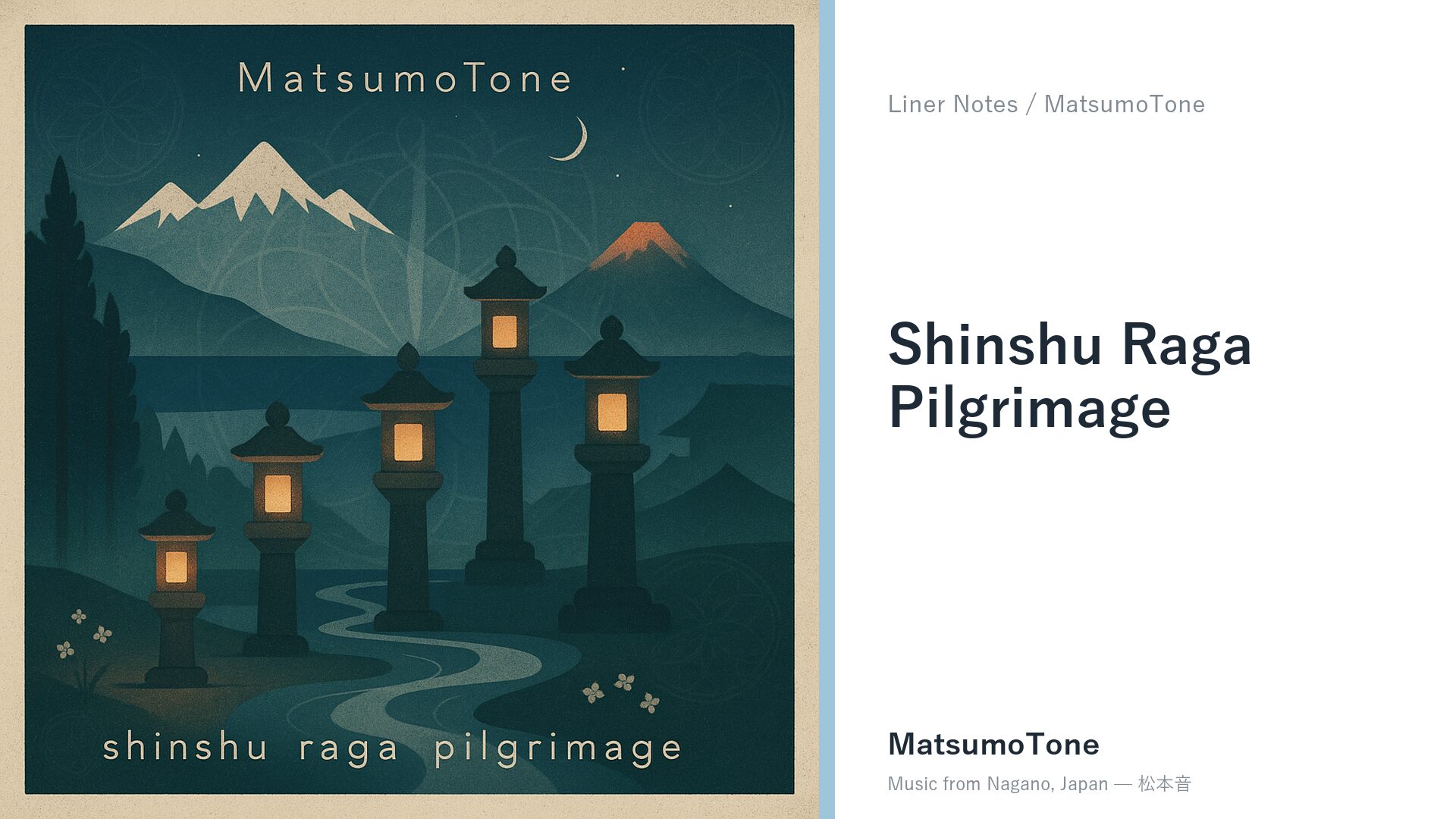
At half past four in the morning at Suwa Taisha, the lake below is still frozen, and the seam of the omiwatari is still visible across it. The raga that belongs to that hour, Mayamalavagowla, is the first one every Carnatic student in South India is ever taught. A beginner’s raga and a dawn raga, carried to a Shinto shrine above a frozen lake. Four more shrines follow it through the same imagined day: Azumino at morning, Togakushi in late morning, Kiso-Ontake at evening, Zenko-ji at night.
Shinshu Raga Pilgrimage is the seventh MatsumoTone mini-album. Five Carnatic raga pieces, about twenty-five minutes in total, in voice-and-bansuri duo form, walking five Shinshu shrines through a single day.
Why Carnatic music, and why Nagano
Carnatic music — the classical tradition of South India — has at its heart a system of ragas that are paired with specific times of day. A morning raga sounds wrong if you sing it at midnight. The system encodes a deep belief about the relationship between sound, hour, and inner state.
Japanese Shinto and Buddhist sacred sites do not have the same explicit time-of-day liturgy, but in practice they have always been visited at particular hours — dawn at certain shrines, dusk at others, midnight at the small ones. The structural intuition of this album: pair five Shinshu shrines with five Carnatic ragas whose traditional hour matches the hour the shrine is most itself.
The duo
Carnatic music is normally accompanied by tabla or mridangam percussion and a tanpura drone box. This album removes all of those. The instrumentation is one female voice singing wordless syllables and one bamboo flute (bansuri) answering. The drone is sustained inside the bansuri itself, by circular breathing. The percussion is the singer’s own hand keeping tala on her thigh.
The radical reduction is partly a matter of fit: this music had to sound right inside a Japanese forest at dawn, not inside a South Indian concert hall. Two voices, one alpine corridor.
Cross-cultural reframing of Shinshu shrines builds on the MatsumoTone idea of place as listening source.

Five ragas, five shrines
1. Suwa Daybreak — 4:30 a.m. The Suwa Taisha Kamisha Honmiya looking out over the frozen surface of Lake Suwa in the season of omiwatari. Raga Mayamalavagowla on D — the first raga taught to every Carnatic student, the raga of the most sacred dawn.
2. Azumino Morning — 7:00 a.m. The roadside stone deities (dosojin) of Azumino, the wasabi fields lit by the long line of the Northern Alps behind them. Raga Bilahari on C — a morning raga of joy and gratitude, with an asymmetric ascent and descent that fits the asymmetric morning light of the alpine plain.
3. Togakushi Inner Sanctum — 10:30 a.m. The cedar-lined approach to the inner shrine at Togakushi, the cave of the hidden sun goddess. Raga Hindolam on D — a pentatonic raga of mystic devotion (bhakti). The wooden flute is in conversation with itself for most of the piece, the singer entering only briefly.
4. Ontake Vespers — 5:30 p.m. The summit of Mount Kiso-Ontake in the falling light, the ritual ablution under a small waterfall complete. Raga Kalyani on F — an evening raga of purification, structurally close to the Western Lydian mode. The most open-feeling piece on the album.
5. Zenkoji Night Hymn — 8:00 p.m. The lit approach to Zenko-ji in Nagano City, the eko-bashira pillar in the centre of the precinct, the night prayer beginning. Raga Bhairavi on D — the great mother raga, traditionally used to close a Carnatic concert. The album closes with the same gesture.
A note on the microtones
Carnatic music uses a 22-shruti microtonal scale that no piano can reproduce. The album does not pretend to be strictly faithful to that tuning — the small intonational instabilities of a sung voice and a wooden flute on a cold mountain do as much work as deliberate microtonal design could. If a trained Carnatic ear hears small inaccuracies, those inaccuracies are part of the album’s honesty about being made far from Chennai.
For a different framing of regional ritual, see MATSUMOTO DON DON, a Bon-odori transposed to a mainstage anthem.
Why Carnatic music, and not Hindustani
South Indian Carnatic music and North Indian Hindustani music are sometimes treated as variants of a single tradition, but they are in fact distinct musical systems with different theoretical foundations, different instrumental practices, and different relationships to vocal performance. Carnatic music is built around composed compositions called krithis, each tied to a specific raga and a specific deity. Hindustani music, by contrast, is more improvisational and more secular in its modern form, with longer expansions of the raga’s mood before any composed material enters. The album draws on the Carnatic tradition specifically because its composition-first structure maps more cleanly onto the album form. A Carnatic recording is comparable in shape to a Western song. A Hindustani recording is comparable to a longer concert performance and does not sit as comfortably in a streaming context.
The duo that performs the album is a violin and a mridangam — the two foundational instruments of a Carnatic chamber ensemble. The violin is played in the Indian style (seated on the floor, instrument resting between chest and ankle, microtonal slides treated as part of the basic melodic vocabulary). The mridangam is a double-headed barrel drum whose two heads are tuned a perfect fourth apart and whose dynamic range is wider than any other comparable Indian percussion instrument. The album was tracked with both players in the same room, facing each other, with a small amount of ambient room ambience captured to suggest the kind of acoustic in which Carnatic music is traditionally heard.
Why these five shrines in particular
Five Shinshu shrines were chosen for the pilgrimage route. The choice was not made from a tourist itinerary; each shrine carries a specific iconographic or seasonal connection to one of the five ragas selected. A shrine associated with water imagery is paired with a raga whose modal character has historically been associated with water. A shrine on the eastern slope of an alpine ridge, whose principal architectural feature faces the sunrise, is paired with a raga that has been historically performed at dawn. The pairings are deliberate cross-cultural matches rather than arbitrary collisions. Whether the matches hold up under scrutiny is one of the album’s open questions. A listener trained in Carnatic theory may find that some pairings work and others do not. The album presents the matches as a hypothesis rather than as a thesis.
Naming the shrines explicitly would force the pairings to be defended as scholarship. Naming them only by direction and altitude leaves room for the listening experience to do its own work. The album’s track titles include cardinal directions and approximate elevations but no place names. Listeners with a working knowledge of Nagano Prefecture shrines will recognise the five locations from those coordinates. Listeners without that knowledge will receive the music as five differently-coloured ragas, each tied to a slightly different temperature and slightly different time of day. Both modes of listening are intended.
Microtonal pitch in a high-altitude environment
The microtones that the violin plays — the small inflections of pitch that are central to Carnatic raga expression — are also affected by physical environment. Cold air refracts sound slightly differently than warm air. High-altitude air is thinner and propagates high frequencies further than low frequencies. A 23-cent inflection played at sea level sounds different from the same inflection played at 1,400 metres. The album was recorded in a studio at sea level, but its imagined environment is the higher-altitude shrines on the route, and the microtones were calibrated to be perceptible at the listener’s expected ear-distance from a speaker in a domestic room — not to the recording studio’s idealised acoustic. This calibration is invisible to most listeners and unimportant for casual listening, but it is the kind of small attention that distinguishes a faithful cross-cultural project from a tourist’s project.
The pilgrimage as a frame, and what it does and does not promise
A pilgrimage in the Japanese sense is rarely a journey toward an ultimate destination. It is more often a circuit — a route that returns to its starting point after passing through a sequence of intermediate sites. The Shinshu shrine routes that the album draws on are circuit pilgrimages of this kind. There is no climactic shrine at the end of the sequence. The fifth shrine is structurally equivalent to the first; the practice’s value is in the act of moving through all five rather than in arriving at any particular one. The album’s sequencing follows this principle. The fifth piece is not the climax. It is the closing of a loop. A listener who hears the album end-to-end ends up roughly where they started, having visited five different rooms in the meantime.
This is a different listening contract than a Western symphony’s. A symphony promises that its later material will resolve tensions introduced earlier. The album makes no such promise. Each raga is its own emotional and modal world; nothing in piece three depends on what happened in piece two; nothing in piece five resolves anything from piece one. The listener is invited to make their own connections, or not. The frame is circular and inclusive rather than linear and goal-directed.
Why a non-Indian performer of Carnatic music
Carnatic music is a tradition with strong lineage requirements. Players normally learn within established guru-shishya relationships over many years; recordings by performers outside that lineage system are usually received with some scepticism within the tradition. The album takes a deliberate position on this question: it presents itself not as a Carnatic recording but as a cross-cultural recording that uses Carnatic instruments and harmonic vocabulary. The distinction matters. A Carnatic recording is judged against the established tradition. A cross-cultural recording is judged against its own stated objective — in this case, the matching of South Indian modal material with Nagano-area shrine geography.
The performers were chosen for their willingness to operate inside that cross-cultural frame rather than for their orthodox Carnatic credentials. They have spent significant time inside the tradition but do not present themselves as its representatives. This positioning is itself part of the album’s argument. Some cross-cultural projects work best when their participants are explicit about their distance from the source tradition. Pretending to authority one does not have is a worse failure than acknowledging the borrowing openly.
A practical note for first listens
Carnatic music rewards repeated listening more than most musical traditions. A single hearing of any raga gives only the outer contour of the modal world it inhabits. The microtonal inflections and the rhythmic cycles that distinguish one raga from another emerge clearly only on the third or fourth pass. The album expects this. First-time listeners are encouraged to treat their initial play as an outer survey, and to return to specific pieces over the following weeks. The pilgrimage frame is itself an argument for repeat practice — pilgrims walk the route many times, and each walk reveals different features of the same landscape.
A final note on accessibility: the album makes no demands on the listener’s prior knowledge of either Carnatic music or Nagano shrine geography. Listeners with deep familiarity in either field will find additional layers of meaning. Listeners without that background will still find the music coherent on its own terms.
How to listen
Shinshu Raga Pilgrimage is available on all major streaming platforms. Hear the full release on Spotify, Apple Music, Amazon Music, and everywhere else.
The recipe, or rather the seed
A raga is a rule set, which sounds like something a generator would love and mostly is not. This paragraph is my attempt at the rules in plain words. Read it as a seed: the machine bent them, and some of the bending was better than the rule. The path was still laid out here. Paste it into Suno’s Styles field, set the dials, and walk the same day.
Settings. With lyrics · Weirdness 30% · Style Influence 80% · Title, Suwa Daybreak.
Carnatic raga Maayamalavagowla on D fundamental, 22-shruti microtonal intonation, suddha-rishabha komal at 90 cents above tonic, antara-gandhara tivra at 408 cents, suddha-madhyama at 498 cents, female open-vowel vocalise on Ah Eh Om La Ma, bansuri bamboo flute breathy ornamented melody, sustained circular-breathing bansuri drone underlay as continuous tonic, vocal-bansuri heterophonic duo, opening alapana free unmetered raga exposition, gradual gamaka oscillations between adjacent shrutis, meend slow glissando, no rhythmic pulse free time, no percussion, no tanpura, no other instruments, small shrine reverb, proximity duo recording, breath noise audible on bansuri, contemplative bhakti aesthetic, serene pre-dawn devotion, heterophonic modal texture, South Indian devotional female vocal tradition

Daybreak alapana at a frozen mountain lake before sunrise; bansuri sustains the D drone through circular breathing while the voice unfolds the morning raga shruti by shruti.
This is the opening piece. The other four days were walked the same way.
The raga is the rule. The key is only how I asked for it. Where it broke the rule is usually where the raga started breathing.
Some streaming links on this site are affiliate links. See our Affiliate Disclosure for details.