
Castle Town Static — Four Backstreet Hours in the Old City
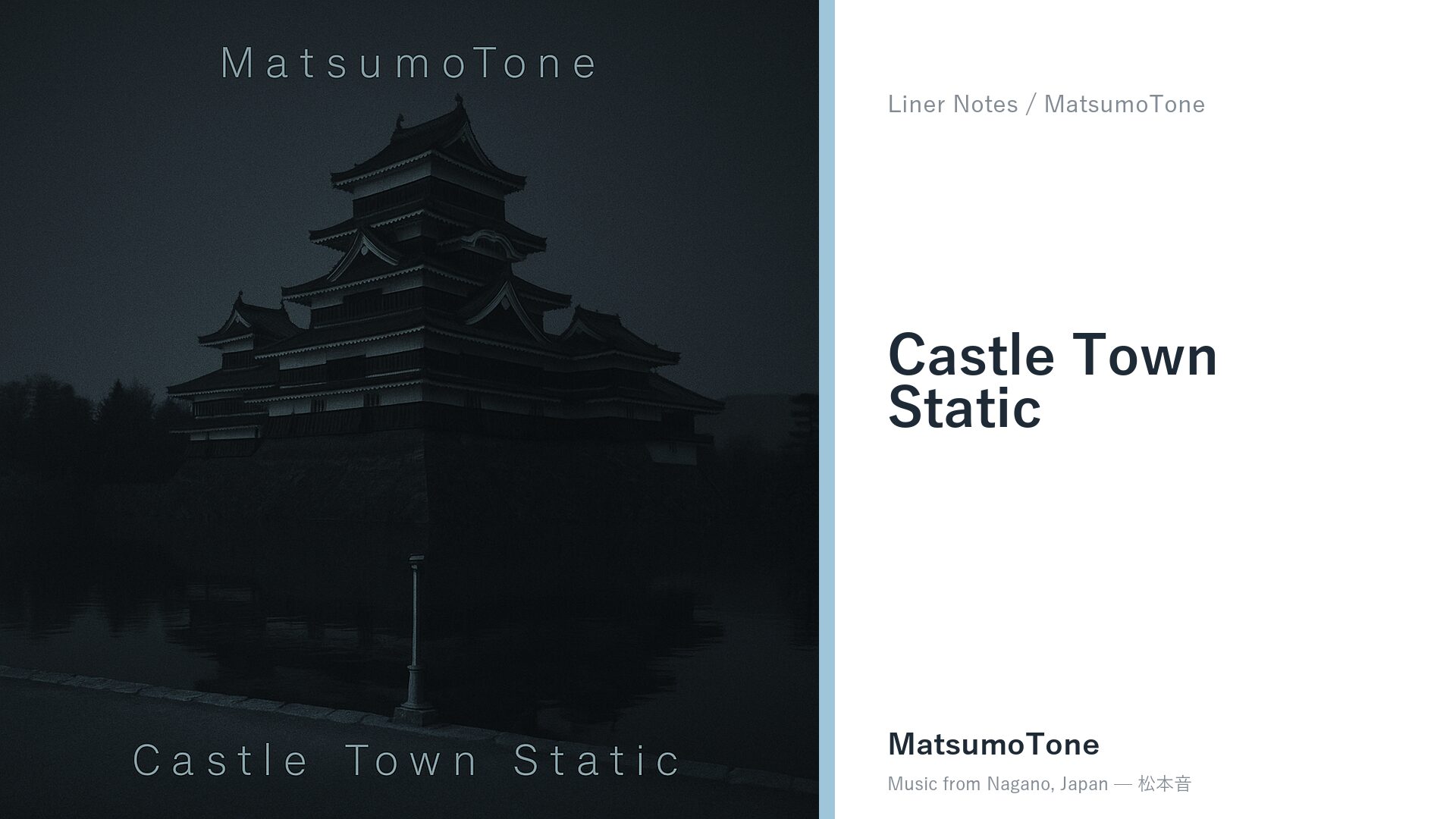
The same night that Matsumoto Night Cassette was happening around the station, a different person was walking the back streets of the old castle town. Same Matsumoto, opposite mood. The shutters were down, the alleys were dark, the moat reflected the streetlamps in a long cold rectangle. The music in their head was not Rhodes electric piano. It was a chorus pedal on a clean guitar.
Castle Town Static is the fourth MatsumoTone mini-album. Four post-punk pieces with male vocal, about sixteen and a half minutes, set in the back streets and moat around Matsumoto Castle.
Why post-punk in a castle town
Interpol, Joy Division, The National, Fontaines D.C. — the lineage of male-baritone post-punk has always been a vocabulary for the lonely walking of a city after midnight. The vocabulary belongs to industrial Manchester, lower Manhattan, north Dublin. It has not often been turned toward a small Japanese castle town.
The hypothesis of this album was simple. The back alleys of Daimyocho, the closed shutters of Nawate-dori south of the river, the empty stone of the moat-side after midnight — these spaces have their own version of the post-punk loneliness. The chorus-pedal guitar fits them the way it fits a Manchester wet sidewalk. Where Matsumoto Night Cassette watched the night from inside, this album walks it from outside.
Four walks, one walk
1. Backstreet 11pm — 23:00. Stone alleys behind Nawate-dori and Daimyocho, shutters down, a faint synth pad sustaining underneath. Key of G minor. The footstep rhythm becomes the kick drum.
2. Old Bookstore Riot — 23:30. A second-hand bookstore on Daimyocho about to close for the night, the kind that has not been organised since 1987. A wall of noise and feedback breaks open in the middle of the song — a stack of magazines toppling, books being shoved back into the wrong shelves. D minor, faster tempo, the most aggressive piece on the album.
3. Sento Aftermath — 00:00. After the public bath has closed, standing on the street outside in the cold air. A short upright bass section in the bridge — a memory of warmth before going home. The key lifts briefly to B-flat major — the III of G minor, the small allowed release.
4. Castle Moat Echo — 01:00. Walking the moat-side around Matsumoto Castle in the last hour before sleep. The black water reflects the castle and the streetlamps in vertical strips. Field recording of the water. G minor returns; the album closes the loop on its starting key, exhausted.
The MatsumoTone approach of mapping a city by its backstreet sounds is set out in the concept post.

Post-punk in a place that isn’t a port city
Post-punk as a genre arose in port and industrial cities in the late 1970s — Manchester, Liverpool, Sheffield, Düsseldorf — and most of its mood still belongs to those geographies. Cold concrete, low cloud, a population economically pressured but socially dense, ruined Victorian architecture standing next to the docks. Matsumoto has almost none of that. It is an inland castle town with a tourism economy, a low building skyline, and weather that is more continental than maritime. Reimporting post-punk into this environment had to begin by acknowledging the mismatch rather than papering over it.
What the genre and the city actually share is a relationship to scale. Post-punk emerged in cities where the streets were narrow, the ceilings were low, and the human body kept hitting against built-form constraints. Matsumoto’s old quarter is exactly such an environment, though by entirely different historical accident — narrow plot widths from Edo-period zoning, two-storey wooden frontages that were never replaced, sightlines closed by the castle moat and the river. The body in those streets carries itself differently. The album takes that as its starting condition.
A note on the vocal
The baritone register sits a little lower than is comfortable for the singer on Old Bookstore Riot — the chorus pushes into a register where the voice loses some clarity. I considered re-tracking. I did not. The half-strained delivery is part of what the song is about: a person at midnight who has run out of energy to make their voice presentable. The cost of that decision is audible if you listen closely. The benefit, I think, is bigger.
A sister album recorded in the same town at different hours: Matsumoto Night Cassette.
Static as a verb, not a noun
The album’s title plays on both senses of static — the radio interference between tuned stations, and the condition of standing still. The four pieces all hover; none of them progress in a conventional verse-chorus-verse shape. Drum machine patterns repeat for minutes at a time, basslines stay anchored to a single root, vocals enter and exit without arc. This is closer to the way the city’s backstreets actually feel between dusk and ten — a long, unchanging interval that nevertheless never sounds quite the same from one second to the next, because of the small drifting noises in the background.
Static, in the radio sense, used to be one of the most common sounds urban people heard — the interval between two broadcast stations on an AM radio. That sound is almost extinct now. The album re-imports a version of it through analog synthesizer noise floors, low-bit drum machine artefacts, and the slow modulation of long-reverb tails. The result is an album that sounds, in the strict sense, alive without ever quite waking up.
The walk that the album traces
Four walks are mapped: a late afternoon route between the castle’s east moat and the station, an evening loop around the small temple district north of Nawate-dori, a colder hour after sundown along the old craftsmen’s quarter, and a midnight return through the side streets behind the bus terminal. None of these are tourist routes. None of them have shops worth mentioning by name. They are routes that a long-time resident walks without thinking, and the album makes a quiet argument that this kind of automatic walking is itself a musical activity. The feet keep the tempo. The body’s slight rotations at corners count out the bars. The city scores the listener without anyone noticing.
Why post-punk, and not no-wave or shoegaze
Post-punk in the strict sense — the music that came out of the UK and central Europe from roughly 1978 through 1984 — is the right reference for this album because of three specific traits the genre owns: rhythmic insistence, vocal ambivalence, and harmonic restraint. Drum machines on a single repeating pattern. Vocals that sit between speech and song without committing to either. Chord changes that happen only when the song would otherwise lose its hold on the listener. Those three traits map almost perfectly onto the experience of walking the back streets of a small Japanese castle town after dark. The repetition is the pavement. The vocal ambivalence is the lack of conversation. The harmonic restraint is the way the buildings refuse to change shape between one block and the next.
No-wave would have been too aggressive for this material. Shoegaze would have been too washed-out, too dependent on guitar bloom to carry the listener over the slow parts. Post-punk’s discipline was the necessary container.
Castle town geometry as a compositional brief
Japanese castle towns were laid out in the Edo period with deliberate irregularity. The streets curve, the corners are not square, the line of sight rarely extends more than a block at a time. This was a defensive design: an attacker could not see far enough ahead to plan. The legacy is a city that, four hundred years later, still does not give the walker a long view. You turn a corner and the city is briefly new. Then you turn again and it is briefly new in another direction.
That geometric stutter is the album’s compositional brief. The drum machine patterns do not modulate; the corners do. New textures enter at the small intervals where, in a real walk, the geography would change — a half-bar of cymbal wash where a building face changes from wood to stucco, a sub-bass swell where the lane opens briefly onto the river. The album is, structurally, a city that withholds the long view from its listener.
The vocal as half-spoken interior monologue
The lead vocal on this album never raises its volume above a conversational level. It is sometimes mixed lower than the snare. It is sometimes inaudible against the long reverb tails. This is not a mixing error. The interior monologue of a person walking home in a quiet town is itself often inaudible, even to themselves — half-formed sentences, fragments of memory, single repeated phrases. The vocal performance translates that state directly. It is not a song that wants to be sung along to. It is a song that wants to be overheard.
When this album works best
Late evening, indoors, alone, with the lights low enough that the room’s edges go dark. The album was sequenced for that hour and that posture. It is willing to be quieter than it sounds in any audio-quality test, because most of its work happens in the long reverb tails and the small drift between bars, which a listener at attention will catch and a listener at attention’s edge will not. Both are acceptable failure modes. The album was not designed to dominate the room.
If a listener has spent any time walking a small castle town after dark — Matsumoto, Hagi, Kanazawa, Matsue, or any of the dozens of similar towns — the album will produce specific, location-grounded sensations. If they have not, the album will still produce a generic version of that sensation, a kind of architectural homesickness for a place they have not been to. That second mode of listening is also intended.
The album’s relationship to the castle itself
Despite the album’s title, the actual Matsumoto Castle appears nowhere in the music. No piece is set in its grounds; no piece references its moat or its keep. This is also deliberate. Castle towns in Japan are organised around their castles, but residents of those towns do not spend their daily lives at the castle. They walk past it, see it from across a river, glimpse it between buildings. The castle is a feature of the city’s skyline, not a place where the city’s life happens. Castle Town Static takes that residential perspective — the castle is somewhere over there, doing whatever castles do, while the album’s protagonist is on a side street trying to remember which way is home.
This orientation is itself part of post-punk’s inheritance. The genre, in its UK form, was rarely about landmarks. It was about the streets between landmarks. The cathedral was not the subject; the bus route past the cathedral was. The album extends that orientation to a Japanese castle town and finds the same logic operating. The keep is a fact about the city, but it is not the city.
How to listen
Castle Town Static is available on all major streaming platforms. Hear the full release on Spotify, Apple Music, Amazon Music, and everywhere else.
The recipe, or rather the seed
Post-punk is mostly restraint, and restraint is hard to ask for in words. This is the paragraph I asked with. Treat it as a seed rather than a specification — a generator never obeys to the letter, and these four pieces later took a re-tracked guitar and a firmer bass. Still, the room they echo in was built right here. Paste it into Suno’s Styles field, set the dials, and start where I started.
Settings. With lyrics · Weirdness 28% · Style Influence 72% · Title, Backstreet 11pm.
post-punk, indie rock, male baritone vocal, chorus-soaked clean guitar, fretless-ish active bass, tom-heavy drums, plate reverb snare, subtle synth pad, G minor, 120 BPM, castle-town backstreets

Male baritone vocal with plate reverb, close-mic. G minor, 120 BPM driving post-punk. Setting: 23:00 walking Matsumoto castle-town backstreets. Form: 8-bar intro, 16-bar Verse 1, 16-bar Chorus, 16-bar Verse 2, 16-bar Chorus, 8-bar Bridge, 16-bar Chorus, 8-bar outro fade. Harmony: Gm-Eb-Cm-D7 (i-VI-iv-V) in Verse, Gm-D7-Eb-Cm in Chorus. Bass plays melodic non-root lines up the modes. Guitar 1 chorus-pedal arpeggios. Guitar 2 reverb-heavy texture. Drums tom-heavy, motorik 16ths. Subtle synth pad below. Wide stereo, reverb-heavy post-punk mix, dry vocal against wet instrumentation. Target duration 3 min 30 sec to 4 min. MINIMUM 3 minutes 30 seconds — must NOT end before 3:30. Do NOT fade out early. Repeat all sections in full as written. Familiar yet undiscovered.
This is the opening piece. The remaining pieces were built on the same bones.
Key and tempo are the aim, not the reading. What it did instead of what I asked is, more often than not, the take that survived.
Some streaming links on this site are affiliate links. See our Affiliate Disclosure for details.