Yorimichi — Four Detours Through Matsumoto in a Single Day
MatsumoTone
MatsumoTone

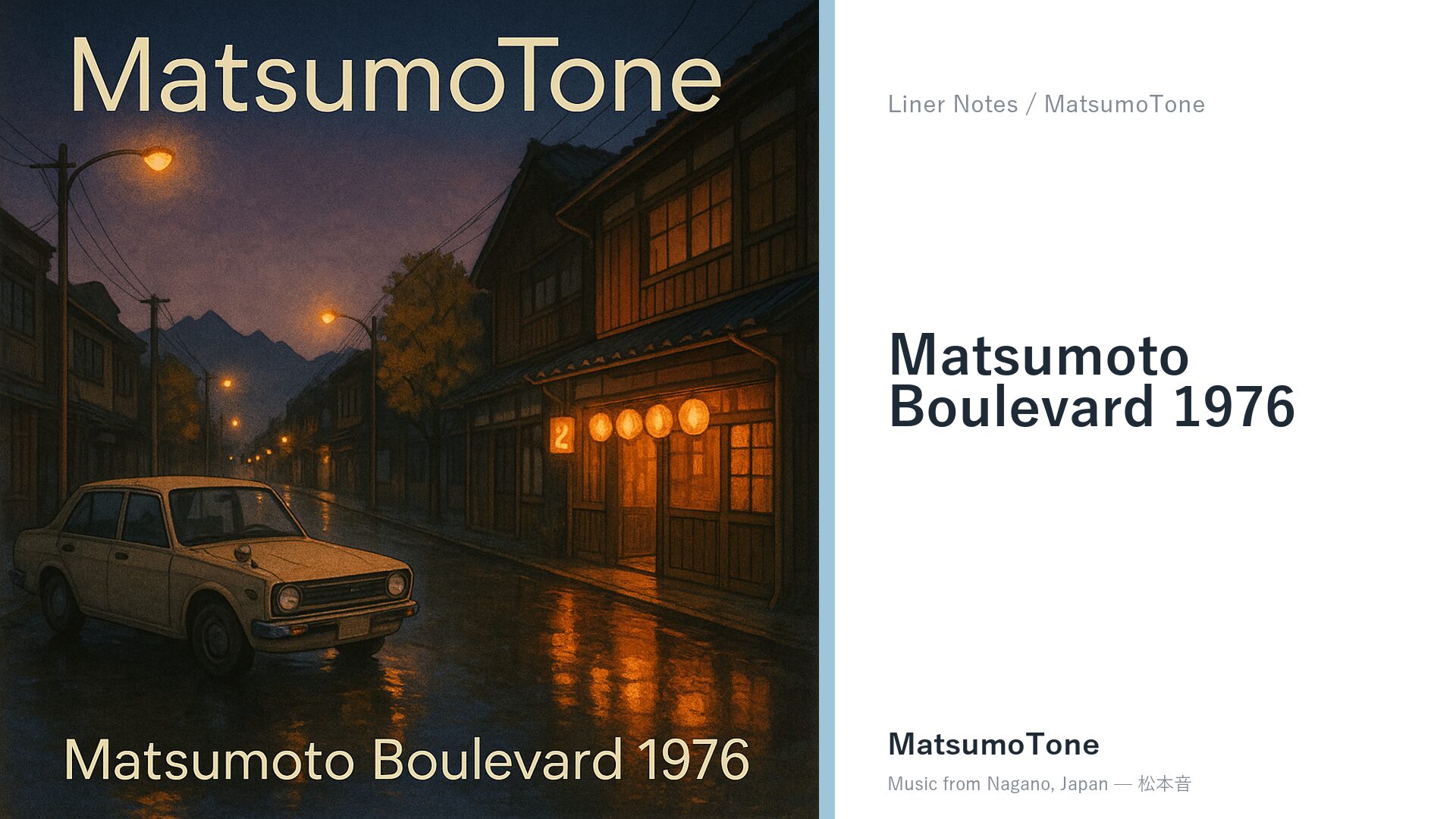
1976 was a specific year for music in regional Japan. The Fender Rhodes had arrived in jazz cafés. The clavinet was on every record. The studios were running tape and discovering analog compression. Bill Evans was still alive. Herbie Hancock had already made Head Hunters. Somewhere in a small bar near Nawate-dori in Matsumoto, on an upright piano with the lid removed, someone was working out the harmonic language of that year for a regional Japanese town.
Matsumoto Boulevard 1976 is the eleventh MatsumoTone release, an album of six instrumental pieces in the 70s jazz-funk fusion vein, about twenty-six to thirty-two minutes in total. The recording is imagined as if it were captured on tape in Matsumoto between June and December of that year.
The year sits exactly in the seam between two eras. Acoustic jazz was still the dominant form in regional Japanese clubs; electric jazz fusion was new enough to feel like an experiment rather than a genre. The Fender Rhodes on a small Matsumoto stage would still draw a few raised eyebrows. By 1979 it would not. The album lives inside that small window.
The album also lives inside a specific kind of Showa-era regional city pace. The boulevard at 9 p.m. is not loud. The shutters along it close at irregular hours. The streetlamps are warm incandescent, not the cold white LEDs of the present. A song in this album has time to develop without anyone in a hurry to hear the chorus.
1. Matsumotojo Nocturne 1976 — Fender Rhodes ballad in F-sharp minor, 74-78 BPM. The lit silhouette of Matsumoto Castle from across the moat, late at night, the way it looked before the surrounding buildings were rebuilt.
2. Nawate Kissaten Groove — Clavinet wah-pedal mid-tempo in G dorian. A jazz café on Nawate-dori in the late hours, the bartender wiping glasses, two people at the counter with their backs to the window.
3. Azusagawa Drive 1976 — Steinway and Rhodes in B-flat major, 78-84 BPM. A car driving along the Azusa River in early summer dusk, headlights catching the water on the curve before Kamikochi.
4. Asama Onsen Lounge — Rhodes lounge groove in D dorian shifting to D mixolydian-flat-six, 88-94 BPM. The lounge of an Asama Onsen ryokan, around 10:30 in the evening, glass clinking, conversation half-finished.
5. Yanagimachi Lamplight — Minimoog street-funk in E-flat minor, 104-112 BPM. The fastest piece on the album. The narrow back streets of Yanagimachi in summer humidity, neon bouncing off wet asphalt.
6. Snow Lodge Closing Set — Rhodes lead and Steinway counter-melody in F major, 64-70 BPM. A small mountain lodge above the snowline, the last set of the night, the few remaining listeners not yet ready to go to bed.
This jazz-funk recasting of Matsumoto continues the MatsumoTone practice of place-as-score — see the concept post.

1976 sits at a specific inflection point in Japanese popular music history. The jazz-funk fusion of the early 1970s — Hidaka, Sadao Watanabe’s New Jazz Quintet era, the early Toshiko Akiyoshi big band recordings — had matured into a confident domestic style. Disco had not yet displaced the rhythm-section orientation. The bossa-fusion and the slow-burn city-pop genres that would dominate the late 1970s and 1980s had not yet been fully codified. There was a brief two-or-three-year window in which Japanese jazz-funk could be itself, without yet being on the way to becoming something else.
This album imagines a hypothetical recording made inside that window, in Matsumoto, by a small group with access to the best session players who happened to be passing through Shinshu that autumn. The conceit is alternate-history fiction with serious harmonic content. The chord voicings are 1976 voicings — Rhodes electric piano with chorus, clavinet on the funk numbers, fretless bass with light flange, brushed snare on the ballads. The mixing is mid-1970s rather than 1980s. The synthesizers, where they appear, are Yamaha CS-50 and Roland SH-2000 rather than the later Yamaha DX-7 era polysynths. Every element is period-locked deliberately.
The opening and closing pieces — Matsumotojo Nocturne and Snow Lodge Closing Set — are designed as a single conversation across the album. Both are slow Rhodes ballads. Both feature the same tenor flute counter-melody returning. The middle four pieces are the boulevard you walk between them. The closing piece is allowed to feel quieter and warmer than the opening, the way going home at 2 a.m. is allowed to feel different from setting out at 9 p.m.
For another night-time read of the same city in a different idiom, see Matsumoto Night Cassette.
Japanese jazz-funk from this era is overwhelmingly associated with Tokyo, the harbor cities, and the Kansai cluster. Matsumoto, as an inland castle town in central Honshu, has almost no documented jazz-funk discography of its own. That absence is exactly the album’s premise. The fiction is that, for a brief season in 1976, a Matsumoto venue — imagined here as a basement room near Daimyocho with a small grand piano and a low stage — became a stopover for session musicians on the way between Tokyo’s recording studios and the alpine ski resort circuit. The album collects six pieces from that imagined residency.
The locations referenced in the song titles and arrangements are real Matsumoto places that would have existed in 1976. The former Kaichi School schoolhouse. The original Matsumoto Station plaza before its 1980s renovation. The covered shopping arcades of Nawate-dori and Ote. The bath districts of Asama and Utsukushigahara. None of these locations had a documented jazz history. The album supplies one retroactively.
The album is sequenced as a bookended set: two slow pieces at the open, two funkier mid-tempo pieces in the middle, and two slow pieces at the close. This is itself a 1970s structural convention — the LP-side architecture from the era when albums were two physical halves, each side with its own arc. The album observes that architecture even though, as a streaming-era release, it has no physical sides. The convention is honoured because the convention shaped the way music from 1976 was heard, and an alternate-history record from 1976 should sound like it was sequenced for the format of its era.
The bookend slow pieces are different from each other in mood — the opening pair leans nostalgic, the closing pair leans valedictory — but they share an instrumental register and a tempo range. The middle pair is where the album earns its funk tag: a clavinet-driven groove number with a horn section, and a slow-burn fretless bass feature with a tenor saxophone solo. The mid-album lift is the album’s emotional centre.
Domestic playback with a decent low-end response. The album was mixed to feel good in a small living room with a single armchair and a low light. Car listening on a long drive also works, particularly on a route that resembles the imagined 1976 Matsumoto geography — undulating two-lane roads through farmland, late afternoon light, a long slow approach to a mountain ridge. Headphones are fine but lose some of the spatial mid-range that the period mix is built around.
The keyboard textures are built around a Fender Rhodes Mark I electric piano with chorus and tremolo, a Hohner Clavinet D6 for the funk numbers, and a Yamaha CP-70 electric grand for the ballad work. The bass is a fretless Fender Jazz, processed through a light flanger on the slower material and direct on the up-tempo numbers. The drums are recorded with overhead room mics rather than tight close-miking, in keeping with the period production aesthetic. The horn section, when it appears, is a tenor saxophone and a flugelhorn — a smaller and warmer choice than the trumpet-and-alto pairing that would have been more typical of harder American jazz-funk from the same era. The guitar is a single semi-hollow body, played clean with light chorus, used mostly for chord punctuation rather than for solo work.
Each of these instrument choices belongs to the mid-1970s, and was in use in Japanese studios in that period. The exact release year of individual models is sometimes given differently by different sources, so the album treats them as a palette of the era rather than as a dated inventory of one particular year. A listener who knows the era will recognise the specific shimmer of a Rhodes Mark I as distinct from the slightly drier Mark II that became common after 1979. The clavinet has the characteristic wah-pedal squelch that defined the mid-1970s funk vocabulary. The fretless bass is voiced in a register that became unfashionable by the early 1980s, when the genre moved toward higher-register slap technique. The album is a careful exercise in not anachronising.
Most jazz-funk recordings from this era were made for, and about, club rooms — small enclosed spaces with a specific kind of warm-bodied energy. This album points elsewhere. Its imagined setting is a wide outdoor street at dusk, with the boulevard’s full length visible in both directions, the light of the western sky turning the building faces amber, and the audible distance between the music’s location and the listener’s ear stretched out longer than a club room could ever accommodate. The reverb decays are tuned to roughly thirty metres of open air rather than to a club ceiling. The sub-bass is rolled off below 60 Hz because outdoor low-frequency propagation does not behave like indoor low-frequency propagation. The album’s mix is, in this acoustic sense, an outdoor record.
That orientation has a Showa-era social analogue. Japanese cities in the mid-1970s were experiencing a quieter version of the same boulevard culture that postwar American and European cities had built earlier — wide sidewalks, evening strolls, residents passing the time in public outdoor space rather than in private interior space. Matsumoto Boulevard 1976 imagines a soundtrack for that kind of evening, in a city that was actually living that mode of life at that exact moment in its history.
The boulevard of the title is fictional. There is no single street in Matsumoto that fits the album’s imagined geography — wide enough for parallel parking on both sides, long enough for an evening’s stroll, lined with the kind of mid-rise commercial buildings that would have housed a jazz basement and a hotel bar within walking distance of each other. The boulevard is a composite, drawn from features of several actual streets in the city’s central commercial district as they existed before the 1980s redevelopments. The composite is more useful than any actual street, because no actual street has all the necessary features at once. The album invents the city it needed.
The album is not, strictly speaking, a nostalgic record. Nostalgia is the longing for an actual past one has experienced. The Matsumoto of 1976 imagined here is not anyone’s experienced past. It is a reconstructed possibility — a version of the city that could have existed but did not quite, and that the album proposes for present-day listeners to inhabit briefly. Listeners who lived through 1976 in any Japanese city will find the album recognisably accurate in its musical period detail. Listeners born much later will find the album recognisably specific to a past they do not remember. Both responses are intended.
Matsumoto Boulevard 1976 is available on all major streaming platforms. Hear the full release on Spotify, Apple Music, Amazon Music, and everywhere else.
1976 is a sound before it is a year, and a generator has to be told which 1976. This paragraph is how I told it. It is a seed rather than a spec sheet — the machine took liberties, and afterwards a Rhodes part and a bass line came from my own hands. But the streetlight in the mix was switched on here. Paste it into Suno’s Styles field, set the dials, and the boulevard is yours too.
Settings. With lyrics · Weirdness 35% · Style Influence 70% · Title, Matsumotojo Nocturne 1976.
Fender Rhodes Mark I jazz-funk ballad 74-78 BPM, F-sharp minor 11 to A-flat major 7 sus4 cycle, Mwandishi-era spiritual jazz of early 1970s. Lydian color tones, modal interchange F-sharp Dorian and Phrygian. Warm vibrato panned phaser on Rhodes. Mallet rim brushes on toms, brushed kick felt not heard. Fretless electric bass walking sustained roots chromatic passing, F-sharp pedal point four bars before resolving. ARP 2600 pad middle register. Wah-clavinet ghost-note 16ths beneath melody. Tenor flute lyrical long-breath unisons. Distant temple bell sample stereo background, faint night wind. Dry reverb on Rhodes, hall reverb on flute. Late-night film-score sensibility. Chord changes every two bars. Tags: spiritual jazz, jazz-funk fusion, modal jazz, Showa Japanese jazz. Production: warm analog mastering, mono-leaning low-end, vinyl-like compression, tape hiss. Structure: intro pad, Rhodes theme, flute counterline, synth solo, theme restatement, fade outro.This is the opening piece. The rest of the album was written from the same corner of the same night.
The BPM is where I pointed, not where it landed. The best bars are the ones I did not ask for.
Some streaming links on this site are affiliate links. See our Affiliate Disclosure for details.