Kamikochi Stillness — Four Hours in the Empty Side of the Mountain Park
MatsumoTone
MatsumoTone

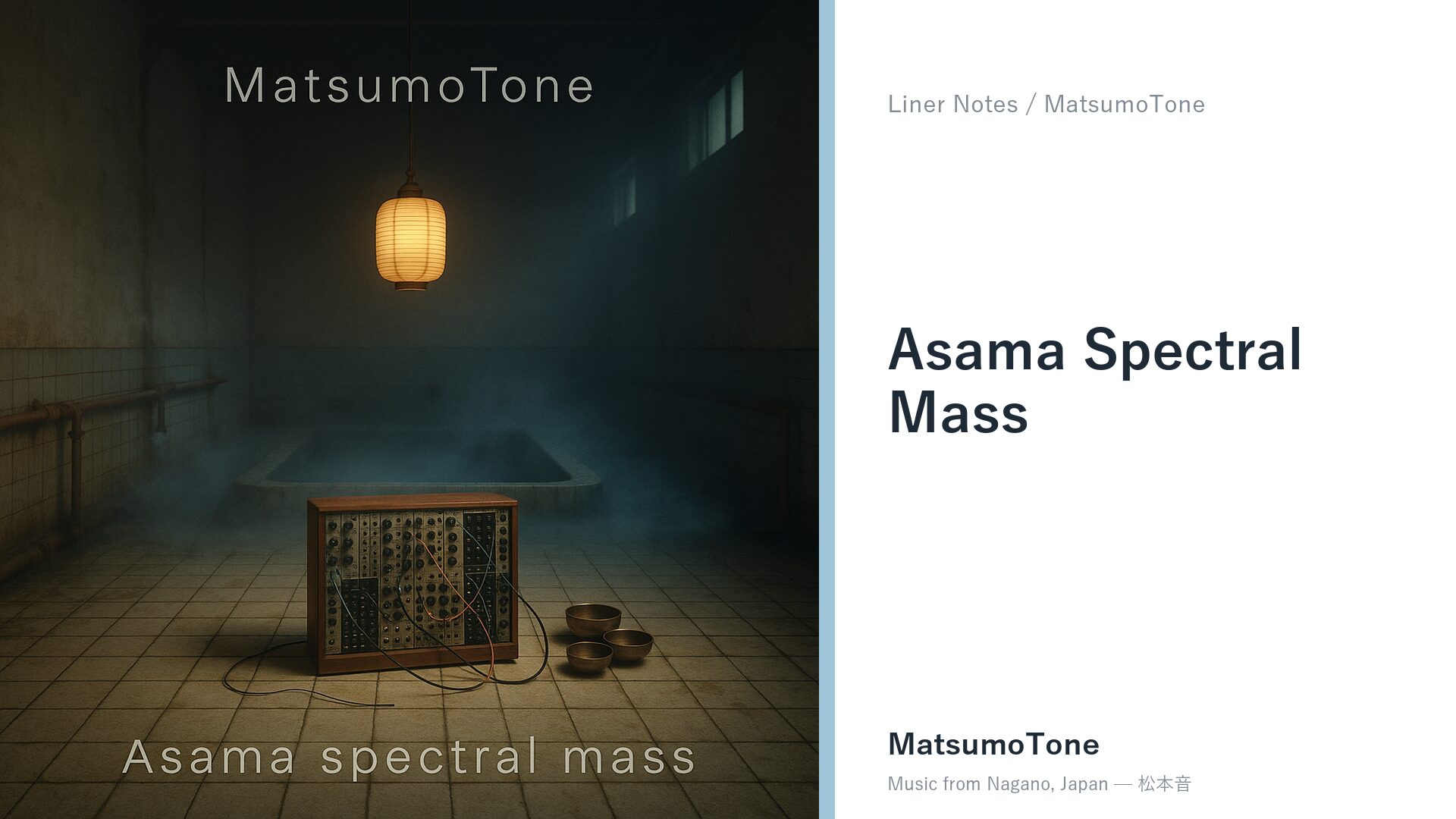
Asama Onsen is the old hot-spring quarter at the eastern edge of Matsumoto city. It has been a healing-water town since the eighth century. Most of its ryokan are still in use; a few of its older bathhouses are not. The premise of this album is to take one of those closed bathhouses — tiled floor, cracked tub, escaped steam still drifting up from a leaking pipe — and treat it as a small cathedral for half an hour in the dark.
Asama Spectral Mass is the sixth MatsumoTone mini-album. Five drone movements, about twenty-two minutes in total, structured loosely as a mass — Kyrie, Credo, Sanctus, Agnus, Ite Missa.
Old Japanese bathhouses share a few architectural features with old European chapels. High ceilings. Stone or tile floors that hold the cold. Tiled walls that throw any sound back at the listener with a long reverb tail. Steam in the air, like incense. Light coming through a single window. Both spaces are designed for the body to sit still inside them in silence.
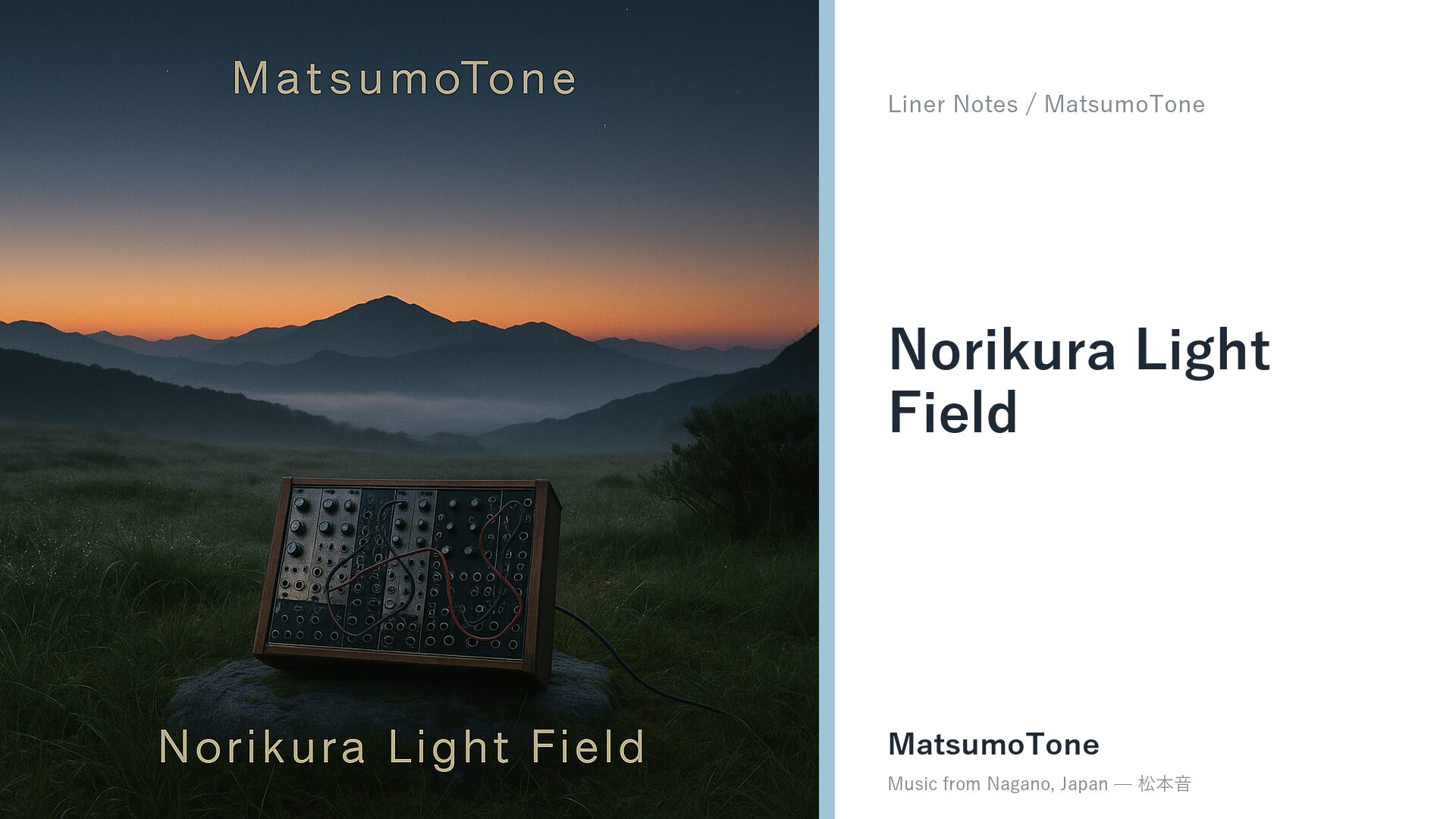
The album leans into that overlap. The modular synthesizer is the pipe organ. The wordless choral pads — breathy syllables, no language — are the steam given a voice. The structure follows the bones of a Latin mass without quoting any of its actual music. Where Norikura Light Field recorded a natural plateau, this album records an architectural interior the natural world has half-reclaimed.
The album is built on the note D, tuned to the natural harmonic series rather than to equal temperament. Each successive movement adds one harmonic to the chord. By the final piece, the chord is D, A, D, F-sharp, A, C, D — the first seven partials, stacked as a single sustained tone. None of these intervals are exactly the intervals a piano would play. The thirds are slightly lower; the sevenths are quite a bit lower. The effect is that the chord becomes more “in tune” as it grows, rather than less — which is the opposite of what a piano-trained ear expects.
The MatsumoTone framework of treating place as compositional source applies here as well — see the concept post.

1. Steam Kyrie — 4:00 a.m. Sub-bass drone, the sound of escaped steam from a single pipe, prayer requested in the slow weight of the low frequencies.
2. Iron Credo — 4:30 a.m. A procession of metallic percussion: temple gongs, prayer bowls, tubular bells struck at slow ritual intervals. The articulation of belief without words.
3. Spectral Sanctus — 5:00 a.m. The full just-intoned overtone stack emerges. The longest piece on the album, the harmonic centre, the moment when the chord becomes a chord.
4. Vapor Agnus — 5:30 a.m. The quietest piece. Only the choral pad and the steam. The lamb of God as a half-formed syllable in escaping vapor.
5. Carbon Ite — 6:00 a.m. The dismissal. Every element of the album fades together. The bathhouse is empty again.
The vocal pad on Vapor Agnus is, honestly, a little less ethereal than I had hoped. The breath texture is there but the resonance feels slightly closer than the cathedral-distant I had in mind. I have left it. A bathhouse at five-thirty in the morning is a smaller, more intimate room than a cathedral; perhaps that is what the sound is telling me.
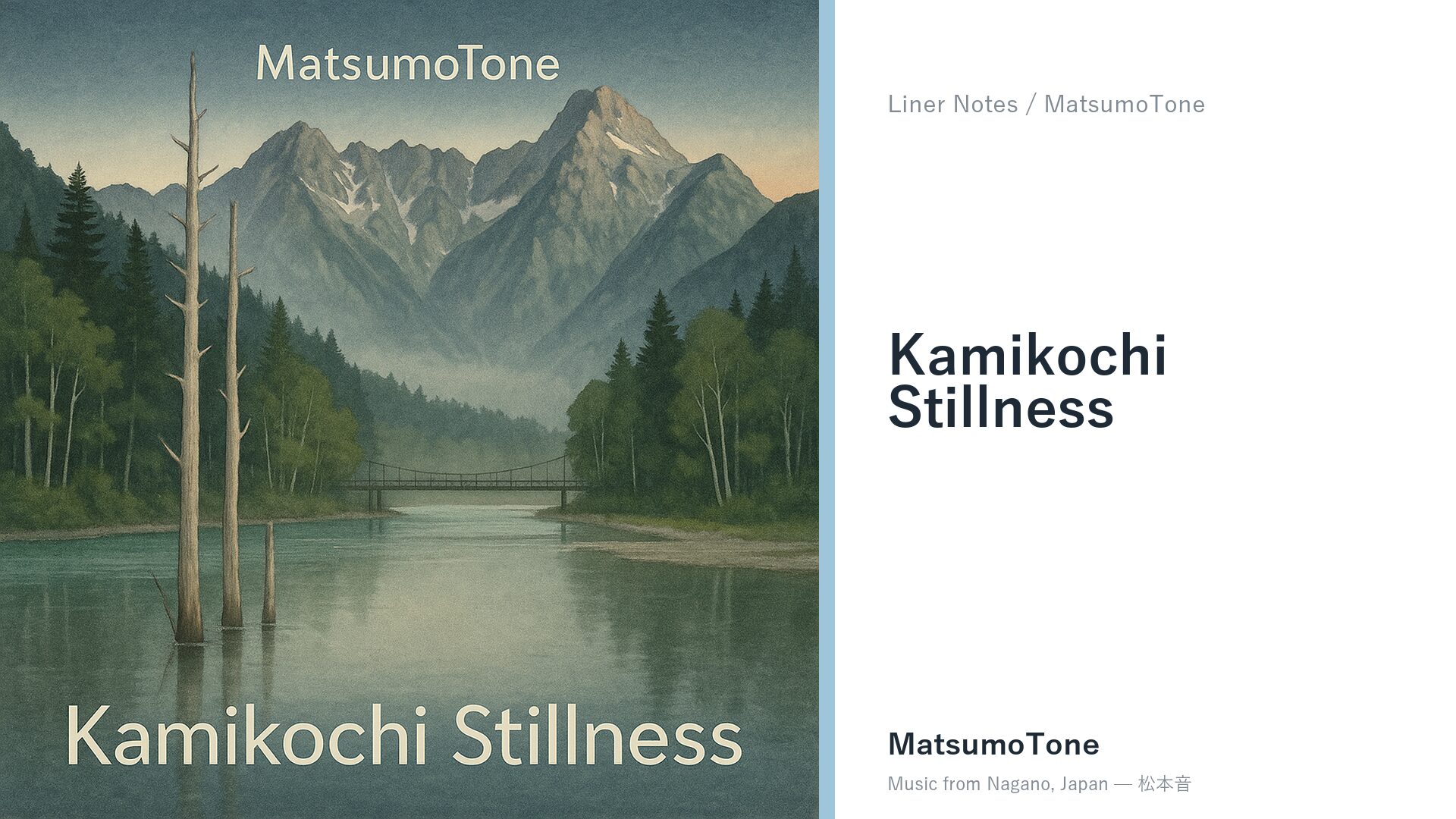
A quieter companion to this spectral piece is Kamikochi Stillness, recorded in another empty alpine valley.
The album’s imagined setting is an abandoned Asama area bathhouse — a small detached building of the kind that closed in large numbers across central Honshu in the 1990s and 2000s as private domestic bathrooms became universal. The remaining structures are typically single rooms with high ceilings, tile floors, a central drain, and large empty tubs of polished stone or concrete. The acoustic signature of such rooms is unusual: very long high-frequency reverb tails because of the tile, moderate mid-frequency response because of the wood frame, and a peculiar low-frequency dead zone at the bottom of the empty tub. The album was scored to that exact acoustic. The choral pad sits in the high reverb tail; the long-bowed strings sit in the mid-frequency live zone; the sub-bass is deliberately kept thin because the empty tub will not propagate it.
Abandoned bathhouses are also charged spaces socially. They were the most communal of all Japanese architectural forms — the place where neighbours of all classes met without clothes — and their disappearance has been one of the quieter losses of recent Japanese urban history. The album treats that history as part of its material. The spectral mass is, in part, a memorial. The mass is for the rooms themselves.
In Western liturgical music, a mass is a specific multi-movement form built around a fixed sequence of liturgical texts. The five movements here do not set those texts; the form’s bones, however, are observed. There is an opening invocation, a long central elevation, a quieter Agnus Dei equivalent, and a final extension that takes the place of the dismissal. The textless choir reads as choral by virtue of timbre and register rather than by virtue of language. A listener with any familiarity with the Western mass tradition will recognise the underlying shape. A listener without that familiarity will simply hear a slow piece of sustained choral and string music that breathes in a sequence of five long arcs.
The word spectral in the title plays on two senses simultaneously. In the musical sense, it refers to spectralism — the late-twentieth-century compositional tradition (Grisey, Murail, Saariaho) that built harmonic language directly from the analysed frequency content of recorded sound rather than from inherited triadic theory. In the everyday sense, it refers to a ghost: the absent occupants of the abandoned bathhouse. The album earns both meanings. Its harmonic content is in fact derived from spectral analysis of recorded fragments of an actual bathhouse’s natural resonance. Its emotional content is unambiguously about the dead.
Asama in this title carries a triple reference. It is the name of the Matsumoto area bathhouse district on the eastern slope of the city. It is also the name of the active volcano Mount Asama some sixty kilometres east of Matsumoto, on the Gunma border, whose 1783 eruption affected weather and crops across central Honshu for years. And it is, by way of the Asama Onsen hot springs, a direct geographical link between the volcano and the bathhouse: the thermal water in the area’s traditional baths is heated by exactly the same underlying volcanic activity that made Mount Asama famous. The album’s title compresses those three layers into one word. The mass is a mass for the volcano, for the bathhouse, and for the geothermal continuity that connects them.
The recording approach was unusual for a contemporary spectral release. The choir was recorded in a real high-ceiling tiled room — not the imagined Asama bathhouse, which is fictional, but a small disused public bath in central Honshu that retains a comparable acoustic. The strings were recorded in a separate session in a more conventional studio environment and then convolved with an impulse response taken from the same bathhouse to place them inside the same imagined room. The two layers were then mixed together with attention to the way real choral and instrumental sounds combine in a tiled space — never identical in onset times, the strings’ attack always slightly preceding or following the choir’s, the result a small natural smear that mimics the imperfect synchronisation of live performance in a reverberant space.
No conventional reverb plug-ins are used anywhere on the album. The reverb is, in every case, either the actual room’s natural decay (for the choir) or the convolved bathhouse impulse response (for the strings and the synthesised tones). This commits the album to a specific acoustic geometry rather than to a generic reverb signature. The album sounds like one specific room. It does not sound like the kind of generalised cathedral reverb that contemporary choral recordings tend to default to.
Japanese public bathhouses peaked in number around 1968, with roughly 17,000 establishments in operation across the country. By 2020 that number had fallen below 3,000. The Asama Onsen area in Matsumoto has held up better than national averages because of the strength of the underlying hot-spring industry, but even there the smaller neighbourhood baths — the ones with single rooms and quiet local clienteles — have been disappearing steadily for thirty years. The closures are usually not dramatic. A retiring owner whose children are not interested in continuing the business; a structural problem that would be expensive to repair; a slow erosion of regular customers in an aging neighbourhood. None of these stories are individually notable. Collectively they amount to one of the most significant unrecorded losses in postwar Japanese urban culture.
The album’s quiet position is that this loss deserves an extended musical acknowledgement, of the kind that western traditions have given to comparable disappeared institutions through requiems and elegies. The mass form is borrowed because it is the form that the western tradition has developed most carefully for this purpose. The borrowing is not an attempt to convert the bathhouse to a Christian frame of reference; it is an attempt to use a well-developed expressive form for a subject the form was not originally written for. The risk of the gesture being misread is real but accepted.
The album does not require any specific listening environment to function, but it benefits from one: a room with a high ceiling, hard floors, and as little soft furnishing as possible. Most contemporary living rooms are acoustically dead — carpets, sofas, heavy curtains — and the album’s already-long reverb tails get clipped by the room before they fully decay. A kitchen with tile floors, a bathroom, a stairwell, or a garage will preserve more of the album’s intended acoustic. Listeners with the option to play the album in such a space at least once will hear material that is otherwise inaudible in conventional domestic settings.
The album is best heard once in full, without interruption, and then revisited in single-movement form. The opening invocation and the closing extension are the album’s two structural pillars and benefit most from being heard inside the full sequence. The three middle movements are more self-contained and survive playback in isolation. A second or third listening, weeks after the first, is the listening that the album was actually composed for; the first listening is a kind of necessary orientation pass.
The album rewards patient repeat listening more than first-impression listening. Listeners who find the opening drone unremarkable on the first hearing are encouraged to set the album aside and return to it a week or a month later under different listening conditions. The album’s content does not change between hearings; the listener’s capacity to register what is in the album does. That trained attention is the relationship the album is asking to build.
Asama Spectral Mass is available on all major streaming platforms. Hear the full release on Spotify, Apple Music, Amazon Music, and everywhere else. Headphones in a dark room is the intended setting.
Drone is the hardest thing to describe to a machine, because almost nothing happens and everything depends on how slowly it happens. Here is the paragraph I used anyway. It is a seed, not a score — the generator drifted, and I pulled some of it back by hand afterwards. But the shape of the mass was set here. Paste it into Suno’s Styles field, set the dials, and you are looking at the same mountain.
Settings. Instrumental, no lyrics · Weirdness 45% · Style Influence 75% · Title, Steam Kyrie.
microtonal sacred drone, just intonation on D fundamental, sub-bass pedal point in lowest register, industrial choral ambient, subtractive modular pipe-organ-register sustain, contact-microphone steam field rec, struck idiophone single prayer bowl with long inharmonic resonant decay, wordless mixed-ensemble breath vocalise on Ah Eh Uh Mm (no consonants, no lyrics), free unmetered time, no rhythmic pulse, no drum kit, harmonic stasis on D, stratified ambient with additive textural accretion, P1-P2 drone polyphony, stone-chamber convolution reverb, very long reverb tail with deep wide stereo, late-1970s European sacred minimalism aesthetic, through-composed processual form

Kyrie of an industrial spectral mass in a derelict onsen bathhouse before dawn. The lowest sub-bass D drone is the harmonic foundation. Wordless choral pad enters as if rising steam itself were singing. A single prayer-bowl strike punctuates the closing with very long inharmonic resonant decay.
This is the opening piece. The other movements were grown the same way, aimed at the same ridge.
The key is a direction here, not a fact — drones do not sit still for a tuner. The drift is not a flaw in the process. It is most of what I kept.
Some streaming links on this site are affiliate links. See our Affiliate Disclosure for details.